With Gas Tax Holiday, Are Texas Dems Pushing ‘Irresponsible’ Policy for Political Gain?
For candidates like James Talarico, calling to suspend fuel taxes may be an easy way to sell “affordability” to swing voters. But it would come with its own long-term policy consequences.
President Donald Trump’s poorly planned war with Iran has paralyzed global shipping routes and spiked the average price of gas by about $1 per gallon nationwide. For three months, Americans have struggled to rationalize both the conflict and the painful prices at the pump, as many work several jobs and side hustles to survive the current affordability crisis. Meanwhile, Trump’s flagrant lack of concern has smashed his purported “America First” promise into bits—and Texas Democrats are scrambling to pick up the pieces.
They’ve started with the cost of gas, one of the most salient barometers for the sitting president’s economic stewardship.
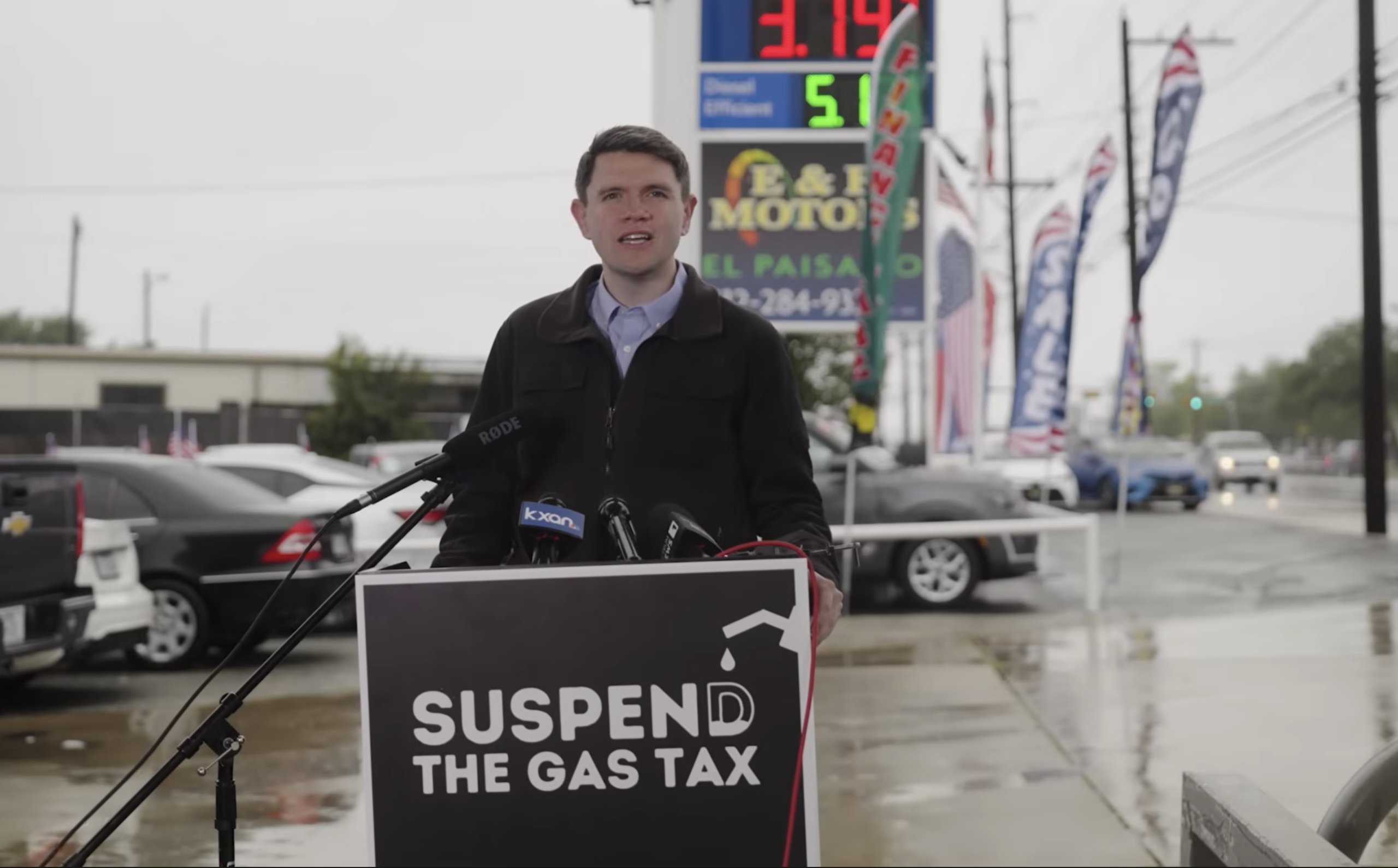
On April 21, Texas’ Democratic Senate candidate James Talarico stood in a rainy gas station parking lot and, in his usual practiced cadence, proposed a suspension of the federal gas tax, which currently amounts to 18.4 cents per gallon on gasoline and 24.4 cents per gallon on diesel. “Americans in the last election voted for two things: to end the forever wars and to make life more affordable,” Talarico said in his address. “But the people in power have done the exact opposite.”
It’s a rather stark departure from the standard Democratic Party line, one that several other party members—in Texas and in Washington—have also rallied behind, including gubernatorial candidate Gina Hinojosa and agriculture commissioner candidate Clayton Tucker. Both Democrats and Republicans in Congress have also embraced the idea to satisfy voters on pocketbook issues. Still, several other Dems in Congress have lined up in opposition. Longtime critics of the gas tax holiday measure say that the idea amounts to scrounging for quarters in a junk drawer rather than focusing on the root cause of inflationary policies; they warn that a gas tax suspension could drastically defund public roadways and education in the long term.
For years, the standard Democratic position on the federal gas tax has been to maintain (or even increase) the tax rate as a means to both shore up the infrastructure fund and curb car travel—one of the largest sources of greenhouse gas emissions. But populist “affordability” politics are in vogue for the out-of-power left as many average Americans face dire financial circumstances. Climate policy, which was all the rage for Democrats just five or six years ago, has now been sidelined as a toxic turnoff.
“Especially here in Texas, they would prefer not to raise the climate issue, because that just opens the door to Republican accusations that Democrats are bad for the oil and natural gas industry,” said Mark Jones, a professor of political science at Rice University. “We’re increasingly seeing Democratic politicians fight fire with fire by engaging in populist rhetoric similar to that of Donald Trump, even if from a policy perspective it’s irresponsible.”
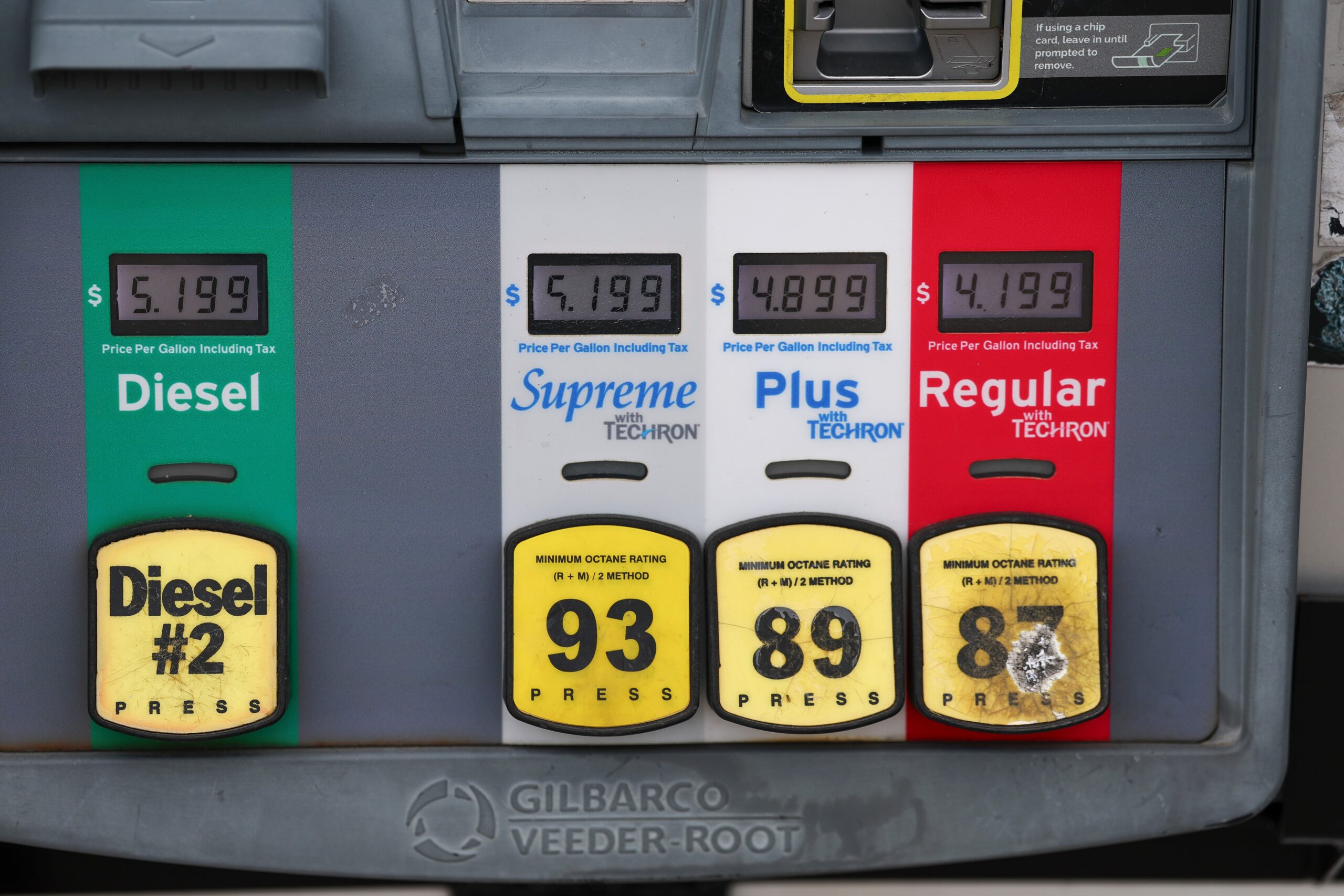
The federal gas tax generates over $20 billion in annual revenue for the Highway Trust Fund, which covers the cost of construction and repair for highways, bridges, and mass transit. (The Texas state gas tax is a flat 20 cents per gallon for regular and diesel, which generates over $3.5 billion annually for the State Highway Fund and the Available School Fund.) A federal suspension for just five months could lead to a $17 billion deficit for the Highway Trust Fund, according to the Bipartisan Policy Center.
This isn’t the first time that Dems have proposed a gas tax holiday to score points on the campaign trail.
During the 2008 presidential race, Hillary Clinton and John McCain tried to undercut Barack Obama by calling to suspend the gas tax. Obama called it a “gimmick that would save you half a tank of gas over an entire summer.”
When gas prices hit an average of $5 nationwide in 2022, President Joe Biden urged Congress to enact a 90-day gas tax holiday. His attempt at regaining the public’s good faith was repudiated by members of both parties, but some states like Connecticut, Florida, Georgia, Maryland, New York, and New Jersey enacted their own tax holidays. Studies of the 2022 gas tax holidays say that consumers in those states saw anywhere from 58 to 87 percent of the cut trickle down to the pump—but the projected revenue losses ranged from $90 million for Connecticut up to $585 million for New York.
Some researchers and policy centers think fuel taxes and fees should actually be increased, not lowered, in order to rescue the Highway Trust Fund. The longstanding principle of fuel taxes is a user pay system: drivers should chip in to upkeep the roads they use everyday. Another factor is the climate cost of burning fuel.

Talarico counters this argument by folding the issue into his broader working class platform against billionaires and corporations. He believes deficits can be made up by ending the “disastrous war in Iran,” targeting tax loopholes, and making the wealthy pay their fair share.
Texas gubernatorial hopeful Gina Hinojosa was among the first Democrats to back Talarico’s proposal. She dropped her own statement two days later, calling on Governor Greg Abbott to suspend the state gas tax using broad emergency executive authority. Over the past month, she has kept up the pressure and accused Abbott of holding out on working families given that the state has a nearly $24 billion budget surplus and a $32 billion rainy day fund.
“This state is a world economic powerhouse,” Hinojosa said. “There is a lot of money that Greg Abbott leaves on the table.”
Abbott’s camp shot back. “The state gas tax is levied on suppliers, not at the pump. That revenue generates well over $300 million per month, which is constitutionally dedicated to fund roads and public schools,” Abbott’s press secretary Eduardo Leal said in a statement. “Looks like Democrats want to defund Texas public schools, but I guess ignorance is bliss.”
Democratic candidate for Texas Agriculture Commissioner Clayton Tucker also jumped on board. He challenged his opponent, honey mogul Nate Sheets, to “stand with working Texans” instead of waiting on Abbott. Tucker said “the greedy few are squeezing Texans from every direction,” while “politicians keep protecting the same rigged system.” Sheets has yet to comment on the issue.
The gas tax holiday is gaining traction even among its past dissenters. Per usual, this swing among Republicans hinges on the axis of Trump. On May 11, Trump said he would support a suspension or reduction of the federal gas tax. That same day, U.S. Senator Josh Hawley introduced a bill to lift the federal gas tax for 90 days—almost identical to the Biden proposal Hawley once blasted as “one of the dumbest things I’ve ever heard of.” The bill’s only measure to recoup revenue for the Highway Trust Fund is to transfer money from the Treasury General Fund, a routine but shortsighted stopgap.
“You have the president of the United States proposing it, and you have Senate Republicans increasingly worried about retaining control of the U.S. Senate,” Jones said. “They look to reducing the price people pay at the pump as a relatively quick fix.”
Senator John Cornyn also said he could live with a temporary suspension, after previously saying it would “explode the deficit.” Even the current Texas Agriculture Commissioner Sid Miller joined the calls to suspend the gas tax after being scorned by his party in the primary, accusing Abbott of “padding” the state treasury coffers while families “struggle to fill their tanks and feed their kids.”
However, President Trump has already rolled back his previous enthusiasm for lifting the tax, appearing confused and unsure about the topic in a late May cabinet meeting. As always, he has proven himself unreliable and unsympathetic, telling reporters on June 10, “I love the inflation.”
At a rally in San Antonio last month, Talarico told the Observer that fuel prices are “the straw that’s breaking the camel’s back,” and that he’s still pushing for the tax holiday. Both longtime Republican and Democratic strategists have said that Talarico’s proposal could help him build the coalition of independent voters he needs to win.
While Jones agreed, he also said it’s highly unlikely the policy is ever enacted. “Then Talarico can have his cake and eat it too,” he said. “He’s on record supporting something that’s popular among voters, but then he never has to reckon with the negative policy consequences.”
You May Also Like

What Will It Take to ‘Get ICE the Fuck Out of Austin’?
Shootings by federal agents are proliferating since Donald Trump took office in 2025, several of them in Texas. To stop it from happening again, local elected officials and prosecutors are hunting for options that aren’t already foreclosed.

Cuba’s Government Is in Trump’s Crosshairs, but Political Dissidents Find No Refuge Here
As the president has mulled invading the island and imposed harsh sanctions, old legal pathways have closed while asylum denial rates for Cubans are near 80 percent.