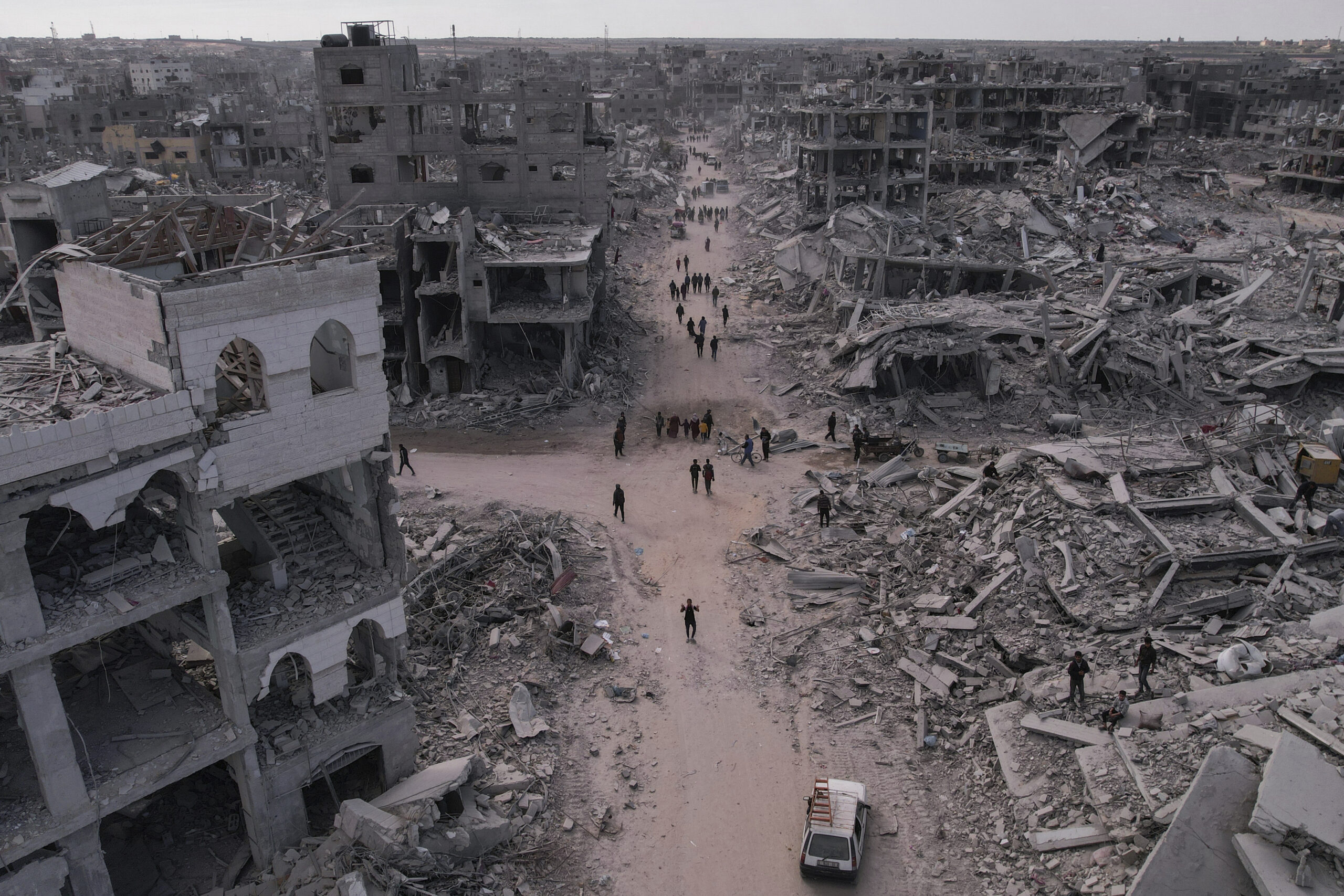
‘After the Genocide, the Genocide’: A Houston Doctor’s Record of Gaza
Fady Joudah’s latest work, “Exhibit G,” charts complicity and erasure with medical precision.
On September 24, a federal judge ruled that the University of Texas at Austin had acted within its rights when it canceled a pro-Palestinian protest in April 2024 and later suspended one of its student organizers. Twelve days later, on October 6, Fady Joudah’s Exhibit G: Poems, Essays, and Photographs of Gaza was named a finalist for the National Book Award for Poetry.
If the three years since the events of October 7, 2023, have been one long court proceeding, argued on college campuses and in the press, whom is Joudah’s new “exhibit” meant to persuade?
“Since the genocide,” he writes in one poem, accounts of Palestine in English have been tasked with absolving “the culture industry of its complicity.”
That phrase “culture industry” comes from Theodor W. Adorno and Max Horkheimer. In 1959, Adorno cautioned that Germany could not work through its Nazi past while the causes of Nazism persisted, and he was wary of anyone impatient to feel clean. Joudah, a Palestinian American and an internal medicine physician at Baylor College of Medicine in Houston, writes of a catastrophe that has not ended. As one poem puts it, “After the genocide, the genocide.”
Yet accounting, too, can help a nation feel clean. In “Late Hussein, Late Ali,” Joudah imagines Israel’s archive of drone strikes: “The civilized keep records to purge their wickedness from the national soul, recollected in tranquility.” Borrowing Wordsworth’s definition of how poetry originates, Joudah turns the phrase against a nation recollecting its violence with a clear conscience.
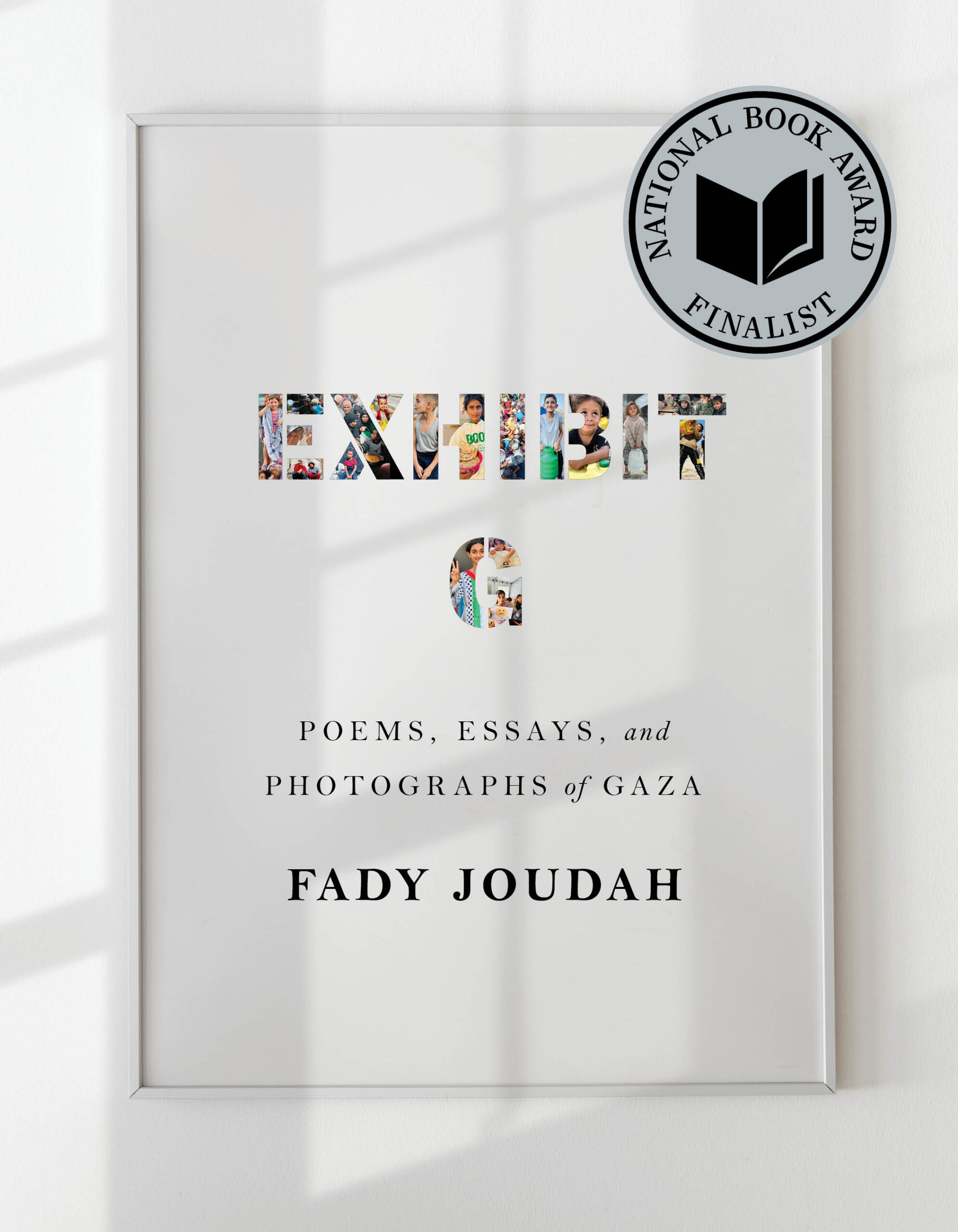
Joudah keeps his own records for a living. In Exhibit G, the medical chart assumes poetic form. He examines Gaza as he was trained to examine a patient. In the essay “A Glass of Water, a Burning Boy,” he describes footage from October 2024 of Shaban al-Dalou burning to death in a hospital courtyard. The fire moves “cephalad,” toward the head, and al-Dalou is “beyond nociception,” past feeling pain.
Asking the reader’s permission for “the vulgarity,” Joudah likens the young man’s raised arms to a pose from Michael Jackson’s “Thriller” video. He then asks: “Is there a death we have not cheapened?” Clinical language keeps the brutality at a professional distance, but the pop-culture reference collapses it.
The essay moves to Houston, to the hospital Joudah works “in, at, or for,” which “spends millions of dollars to drag a single American life out of imminent death.” One spring, a retired physician kept his dying wife on life support for three weeks, until the couple could reconcile “with futility on their own terms.” The wife, an arts patron concerned “only about beauty,” not mortality, called Joudah Dr. Death. “She couldn’t have known,” he writes, “I was in the middle of my genocide.”
In Gaza, there was no such time for reconciliation. Bystanders threw a blanket over the burning al-Dalou, which the fire devoured on contact. What links the two deaths, Joudah writes, is “a healthcare system borne of a system that spends gazillions to annihilate other lives in wars.”
He records an American doctor’s verdict on Gaza’s vanished doctors: Only “animals for physicians” would abandon their patients as they did. Joudah’s reply is addressed to the reader: “Your good, kind doctor said it. Your next appointment.”
Most of the book’s photographs come from the Gaza Soup Kitchen, which Joudah’s friend Hani Almadhoun started “in lieu of grief” after Israel killed five members of his family. They show children lining up with pots and water jugs—almost none of the carnage American readers have learned to expect.

Joudah interrogates how such pictures get made, and for whom. In “Exhibit G: Surviving Image,” adults remind the children to smile, and the photographers, “thirsty and hungry as the kids,” also “shoot for the donors in the USA.” A reader who knows how the smiles are produced can find no easy comfort in them. Joudah asks: “What image of childhood is enough for a people to stay alive?”
Another poem transposes Adorno’s dictum—“To write poetry after Auschwitz is barbaric”—for the news cycle: “In a species where the news commits genocide, / one should not report news after Gaza.” Two photographs follow: boys and young men pushing dented pots through a gap in a concrete wall and two photographers pointing long lenses toward them.
Portions of Joudah’s record are redacted. The brackets that titled his previous collection in 2024, […], return in “Late Hussein, Late Ali”: “On March […], on the […] of Ramadan, during year one of our genocide, on the day you abstained, and the resolution passed, a legislative absolution in which I and my family tree were non-binding— / and with the aid of your AI eye in the sky, Israel killed Hussein.”
The brackets withhold the date, but the sentence points to one. Hussein was killed after the United States allowed a United Nations Security Council ceasefire resolution to pass by abstaining from the vote, then dismissed it as non-binding. Hussein was 22, a recent graduate, who was just months from his commencement when the “extermination began.” His younger brother, Ali, was killed months later. “No colleges, only dust,” Joudah writes.
“The premier demand upon all education,” Adorno said in 1966, “is that Auschwitz not happen again.” Joudah has less faith in schools. Gaza has gone without them for “a year, now two, then three and counting,” he writes in “Surviving Image,” and, in an empire, education is “the incubator of illuminators and eliminators.”
He sees one defiant exception in the student encampments of 2024. “Where else in the US today,” he asks, in “Baby Moses & Khalas,” “is a shared living space capable of organized resistance?” The state, he notes, “comes down hard on universities to disintegrate the last, albeit flimsy, effective physical presence of community in America.”
Texas has proved him right. In the UT case, Judge Robert Pitman relied on Tinker v. Des Moines, the 1969 Supreme Court ruling best known for protecting students who wore black armbands to protest the Vietnam War. It also permits schools to restrict speech when they reasonably anticipate substantial disruption. Pitman found that UT had—even though its own police anticipated a peaceful protest.
Rice University, where I study, is private, and its policy defines a demonstration as “one or more persons” and lets officials revoke approval “at any time and for any reason.” Both universities govern protest by what might happen. Exhibit G, true to its title, is evidence of what already has.
Get the newsletter
“All hope is local,” Joudah writes in “Symphony in G Major.” For him, local often means his garden in Houston. In the book’s final lines, he discovers a monarch butterfly dead there: “Whatever failed her, migration / or procreation, wasn’t wicked to her. / I stroked her powdered wings / and left her for the ants.”
Hers is one of the few deaths in Exhibit G that no person caused, but Joudah treats it no differently than the rest. He looks closely, and he writes.


