The Pecos Insurrection
How a private prison pushed immigrant inmates to the brink.

Last Dec. 12, on the outskirts of Pecos, Texas, the immigrants doing time in the world’s largest privately run prison decided to turn the tables on their captors. It was the Day of the Virgin of Guadalupe, an important religious holiday in Latin America. But the inmates were in no mood for celebration.
The motin, as the overwhelmingly Spanish-speaking inmates called their uprising, began in the Reeves County Detention Center‘s Special Housing Unit (SHU), better known as solitary confinement, with two men—a Honduran and a Mexican—using the wires in an electrical outlet to set a mattress on fire.
They broke out the windows of their cell, and when prison guards tried to extinguish the fire by sticking a fire hose through a port in the door, the two broke the sink off the wall and held it up as a shield. One brandished, but didn’t use, a “shiv,” a crude jailhouse knife. Meanwhile, the two men yelled for other inmates to join in the uprising. Soon, at 12:45 p.m., a lockdown order went out across the prison. Staff tried to hustle prisoners on their way to lunch or the recreation center back to their cells. Inmates in one of the housing areas refused, and they forced the guards to release friends from their cells. “Open the doors or we will take your keys,” the prisoners demanded, according to an FBI account. “We’ll see who has control in a bit,” one inmate told a guard.
The prison’s emergency-response team deployed an arsenal including rubber bullets, pepper spray, expulsion grenades and bean-bag guns. To little avail. The insurrection quickly spread to the other housing areas. The rioters assembled in the outdoor recreation yard armed with rocks, concrete, and steel poles as well as horseshoes, hammers and box cutters they had pilfered from the recreation building. Many of them, aware of the prison’s extensive surveillance system, hid their faces with T-shirts, hats and bandanas. Some wore sunglasses.
Two prison employees were taken hostage. (Neither was harmed.) With more than 1,200 inmates milling around outside and hordes of law enforcement officials, the prison must have looked like a war zone.
It was not mere anarchy, though.
By midafternoon, members of the FBI, Texas Rangers, DPS and the Odessa Police Department arrived at the prison. As the crisis negotiators quickly found out, the riot had not been prompted by gang infighting, racial tensions or a spontaneous outburst of violence. The men incarcerated at the Pecos prison are considered “low-security”; most are serving relatively short sentences for immigration violations or drug offenses. All are set to be deported at the end of their sentences.
Leaders of the rebellion were demanding a meeting with the Mexican Consulate, the FBI and the warden to discuss a number of grievances that they said GEO Group, the prison company that manages the 3,700-bed facility, had refused to address.
The evening of the uprising, the inmates sent a delegation of seven men—a Venezuelan, a Cuban, a Nigerian, and four Mexicans—to meet with the authorities.
They explained that the uprising had erupted from widespread dissatisfaction with almost every aspect of the prison: inedible food, a dearth of legal resources, the use of solitary confinement to punish people who complained about their medical treatment, overcrowding and, above all, poor health care.
The delegates pointed to a string of deaths (according to public records, five men died in Reeves between August 2008 and March 2009, including two suicides) they attributed to the prison’s inattention to medical needs. The riot had been sparked by the death of Jesus Manuel Galindo, an epileptic, who had been carried out of the prison’s Special Housing Unit in a body bag that same day. “Suspect(s) are talking about the guy being out of the shoe [SHU],” the Odessa Police Department report said. “Someone should have been there with him. Special housing was not the place for [him].”
The authorities jotted down the concerns and promised to take them seriously.
Twenty-four hours after it began, the uprising was over. More than $1 million worth of damage had been done to the prison. Less than two months later, on Jan. 31, the prison would be under inmate control again—and this time the rioting would last for five days and end with one building destroyed and some $20 million in damage.
To critics of GEO and other for-profit prison companies, the two huge riots in as many months—rare, especially in low-security prisons—were the logical consequence of the largest experiment in prison privatization to date.
The story of the death of Jesus Manuel Galindo is the story of a death foretold.
For weeks, Galindo, a 32-year-old epileptic Mexican citizen who had lived in the United States since he was 13, had been complaining to anyone who would listen that something terrible was going to happen to him because of poor medical care.
In May 2007, Galindo was found illegally crossing the border in El Paso. Galindo, nicknamed “Negro” for his dark complexion, was sentenced later that year to 30 months for illegal re-entry (crossing into the U.S. after being deported). Ten years ago, he would likely have been quickly deported, not prosecuted. But the Bush administration piloted a “zero-tolerance” policy in Texas that eventually spread across the border: All illegal border crossers would be arrested, detained and, if possible, prosecuted in federal court. Prosecutions surged, as did the need for detention centers, jails and prisons to hold the tens of thousands of newly minted criminals. The Obama administration has more than embraced the policy. The number of prosecutions for immigration crimes—almost 68,000—during the first nine months of 2009 is on track for a 14 percent increase over 2008. More than half of those prosecutions took place in Texas.
The result has been a system swamped with low-level immigration cases and prisons bursting at the seams with illegal immigrants. Rather than build and run the facilities themselves, federal agencies have turned in large part to private prison companies, such as Corrections Corporation of America and GEO Group. In 2008, GEO reported more than $1 billion in revenue, an 80 percent increase over 2005.
Privatization has been less profitable for others. GEO’s Texas facilities have been plagued with suicides, filthy conditions, sexual abuse scandals, hunger strikes, riots and lawsuits.
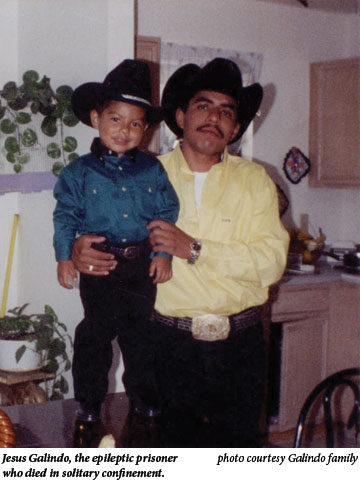 Jesus Galindo became another case in point. According to his family, Galindo had had seizures before his incarceration but they grew worse and more frequent under the care of the Physicians Network Association, a Lubbock-based medical services provider that serves 17,000 inmates in 24 facilities across the nation. In 2002, Reeves County hired PNA to run the prison’s health care, attracted by its promise to improve services and cut costs. (The county pays PNA $6.03 per inmate per day, about $8 million a year at full capacity.)
Four months into their contract, then-warden Rudy Franco lauded PNA at a county commissioners meeting for drastically reducing the number of surgeries, X-rays, outside visits and other medical services, the latter of which had dropped from 3,148 to 222.
On Nov. 12, Galindo was locked up in the Special Housing Unit. The mostly Spanish-speaking inmates call it la celda de castigo, the punishment cell. Prisoners and others say the SHU was frequently used to isolate and punish men with health problems who complained about their medical care.
According to Galindo’s family, the prison authorities said they put him in the SHU to keep an eye on him. “That’s not true,” says Jesus Galindo Sr., his father. “It was to punish him.”
Galindo pleaded with prison officials to return him to the general population where he had friends who woke him up to take his pills and took care of him during his frequent seizures.
“He would say he was really afraid because if he got sick who was going to help him?” says his mother, Graciela Galindo. She begged officials to look after her son. “They told me he was in a high security place; that was what the warden said, and that I should not worry about him. They told me they were taking good care of my son.”
Galindo did what he could to reassure his family, singing love songs to his mother over the phone. “He had hope,” his brother Jesus Galindo Jr. said. “He was real strong. The only thing that bothered him was his condition. I saw him on his birthday [Nov. 29]. I said, ‘Hey, hang in there. Think of us like we think of you.'”
Judy Madewell, the public defender in charge of Galindo’s criminal case was so worried that she sent an investigator to the prison on Dec. 4. The investigator, Octavio Vasquez, urged the authorities to put Galindo back into the general population.
On Dec. 9, Graciela talked to her son on the phone. “He told me to tell Belinda [his daughter] to do a dance to the Virgin because he’s getting out of the SHU on Friday [Dec. 12] … and that if he wasn’t, to contact the jail.”
The following day, Dec. 10, Galindo wrote a letter to his family saying that he felt bad and had asked the doctor and warden to do something. The letters begins in the morning, with Galindo noting that a nurse had promised him that she would return later that day to take his blood.
Two days later, on Dec. 12, Graciela called to see if her son had been released from the SHU. “I called and to my surprise he was dead. They kept me on the phone for an hour. They said we have to wait for the doctors. I told them please do something. But my son was already dead.”
“Mama, the day already passed and nothing,” he writes later that same day. “All they did was walk up and down but here, where I am, no one even stopped. We’ll see what happens tomorrow.”
When Galindo was found in his cell, rigor mortis had already set in. His body was purple and stiff. The El Paso County medical examiner ruled the cause of death as epileptiform seizure disorder. A toxicology report found “below-therapeutic levels” of Dilantin, a cheap anti-epileptic drug, in Galindo’s blood and urine. The drug is only effective at certain dosages, and a patient’s blood must be checked regularly to make sure it’s not too high or low, says Robert Cain, an Austin neurologist who reviewed the autopsy.
“With multiple seizures, inadequate levels of medication and left in isolation without supervision, he was set up to die,” Cain says.
Galindo’s experience was strikingly similar to those of other inmates under PNA’s care. In 2003, the Justice Department investigated the Santa Fe County Jail in New Mexico, which was then run by Management & Training Corp. (MTC). Just as it does at Reeves, PNA had a subcontract to provide health care there. The Justice Department found nearly non-existent medical and mental health care, and specifically noted PNA’s inattention to properly calibrating dose-sensitive medications, especially anti-epileptics.
“We found several instances in which PNA failed to monitor inmates on these types of medications, even when inmates reported experiencing side effects,” the report states. In one case, blood testing showed that an inmate with a seizure disorder did not have enough of the anti-seizure drug to be effective. The PNA medical staff did nothing, and seven days later the inmate attempted suicide and then suffered a seizure. “Even with all the attention from medical staff due to his suicide attempt, his seizure medication blood level was not measured until four days” later, the report says.
No such authoritative report has been done for the Pecos prison. But in interviews and correspondence, prisoners, their relatives, attorneys and immigrant rights advocates describe a facility overrun with corruption and dangerous cost-cutting measures. Prisoners writing to the Observer have made allegations ranging from physical abuse to tacit arrangements between guards and prisoners to traffic drugs and other contraband inside the facility. (GEO Group declined to comment.)
A prisoner we’ll call Juan, who asked that his real name not be used for fear of retribution, describes an environment of fear where hardened criminals serving long sentences live side by side with men who are there solely for crossing the border illegally. Juan says that prisoners in the jail are divided into groups based on their home state in Mexico with the tacit approval of the guards and the warden. Prisoners who have money and can buy influence and authority run these groups. These bosses dole out punishments and determine with the guards who gets sent to the punishment cell, Juan says. “We are threatened and beaten if we complain. While [the prison bosses] can have cell phones and other benefits that are forbidden.”
Another prisoner, Jose—who also asked that his name be changed—writes that he has hepatitis. “I begged for medicine and they sent me a bottle that was unsealed and only half full,” Jose writes. “I haven’t received treatment for my hepatitis since December 2008.”
“The problem with Reeves is that there are no medical services,” says Graciela Arredondo, the mother of a man who served part of his sentence at Reeves. “They won’t bring a doctor if you are sick. They don’t want to spend the money, but these are human beings and they deserve medical services.”
After the riots in December and January, the ACLU of Texas called on the Department of Justice’s Office of the Inspector General to investigate the prisoners’ charges. This wouldn’t be the first time the OIG was asked to look into reports of abuse at the Reeves facility. In 2006, an investigation resulted in the arrests of five employees at the jail for smuggling drugs into the facility and having sex with inmates. Because it hasn’t received an answer from the OIG, the ACLU is starting its own investigation.
“Riots are relatively rare, and are an indicator of serious problems at a facility,” says Lisa Graybill, legal director for the ACLU of Texas. “We continue to receive complaints that the Bureau of Prisons and its contractors, GEO and Physicians Network Association, are systemically failing to address life-threatening and chronic medical conditions of detainees.”
None of this is surprising to longtime prison activist Bob Libal, co-coordinator of Grassroots Leadership, an Austin nonprofit that fights private prisons. “Conditions at GEO facilities have been horrendous, and it stretches across every type of facility,” says Libal. “It’
case after case after case. Whether Coke County, Val Verde, Di
kens County, Reeves, Pearsall, it’s one horrendous thing after another.”
In 2007, the Texas Youth Commission removed 197 youths from GEO Group’s Coke County Juvenile Justice Center after inspectors found deplorable conditions including filthy cells that reeked of feces and urine, insects in the food, and inmates only being allowed to shower and brush their teeth every few days.
A year before, the family of 23-year-old LeTisha Tapia sued GEO Group after Tapia killed herself at the Val Verde County Jail, which the company runs. Tapia had told her family that she was raped, beaten, sexually humiliated and deprived of psychological and medical treatment in retaliation for telling the warden about guards allowing inmates to have sex with each other. The suit was settled out of court.
In the past two years, the state of Idaho has pulled out of contracts at two GEO-operated jails—the Dickens County Correctional Center, near Spur, and the Bill Clayton Detention Center in Littleton—citing chronic understaffing, a lack of required treatment programs, and suicides linked to squalid conditions.
In a lawsuit set to go to trial in March, two detainees at the GEO-run South Texas Detention Complex in Pearsall claim that the company “intentionally and systematically violates the rights of mentally disabled detainees.” Echoing the Reeves County allegations, both of the plaintiffs, Miroslava Rodriguez-Grava and Isaias Vasques Cisneros de Jesus, allege that instead of treating them for their mental disabilities, GEO put them in segregation for extended periods of time.
“I think that any time you insert profit into the equation that care and also the rehabilitative elements of corrections goes out the window,” said Libal. “They try to do things as cheap as possible. You get what you’re paying for in a lot of ways.”
The Pecos prison, a remote, austere correctional campus flanked by farmland and a weirdly out-of-place cemetery, sprawls across several acres a few hundred yards from Interstate 30. To travelers zipping by at 80 mph, the facility is little more than a blur of barbed wire and guard towers. But to the people of Reeves County (population 13,137), it’s an engine of progress.
In the mid-1980s, with the regional economy devastated by the Texas oil bust, local business and government leaders decided to move into a recession-proof industry that was exploding in an increasingly criminalized America: prisons. In 1986, the county built a 300-bed prison. The prison filled rapidly with federal inmates, pumping revenue into the county’s budget and adding decent-paying jobs to the local work force. By 2002, Reeves had 2,000 beds. In 2003, the county completed construction on a $39 million, 960-bed unit only to find that the feds had no interest.
“They built a $39 million prison on speculation,” said Jon Fulbright, a reporter for the Pecos Enterprise. While the prison sat empty, payments on the bonds, reduced to junk status, were coming due. On the verge of default, county officials begged the Bush administration to send prisoners and hired Randy DeLay, former House Majority Leader Tom DeLay’s brother, to lobby in Washington, D.C. That’s when Wackenhut Corrections Corp., now GEO Group, rode to the rescue. In November 2003, GEO agreed to take over management of the whole 3,000-bed prison complex and soon struck a deal with the Bureau of Prisons to fill the new unit.
Despite the troubles at the Pecos prison under GEO management, local officials are grateful.
“A lot of people criticize GEO but I don’t,” says Sheriff Arnulfo “Andy” Gomez. “We had a hard time and they pulled us out. They’ve got lobbyists and all that.” Besides, he says, “You’re going to have trouble in every prison.”
Some more than others. On Jan. 31, a month and a half after the first uprising, prisoners at the Reeves County Detention Center rose up again. Prison and law enforcement officials have released little information on the disturbance, but inmates, advocates and family members say it began when Ramon Garcia, 25, was forced into solitary confinement after complaining of dizziness and feeling sick.
“We spoke with the warden and we told him to take our countryman out of the punishment cell and take him to the hospital because he needs medical attention,” an inmate told Laura Rivas, an advocate with the National Network for Immigrant and Refugee Rights. “We told them that if they were not going to do it then we would do it, we would take him out, because we have more strength, and they laughed at us. And that’s when it all started.”
Lana Williams, a friend of Garcia’s family, told KFOX-TV in El Paso that Garcia had been put into solitary confinement whenever he complained of feeling sick. “He’s gotten to the point where he can’t walk down the hall without holding on to the wall, and this has been going on and getting progressively worse,” Williams said.
During the five-day takeover, the inmates drafted another list of demands: better medical treatment, adequate food (especially for those who are ill or have diabetes) and no guard retaliation against any person.
“To them, we don’t matter,” the inmate told Rivas. “If we die, it doesn’t matter to them. The only thing that interests them is money—nothing more.”
Melissa del Bosque contributed reporting for this story.
You May Also Like

Black Texans Built More than 400 Schools When the State Would Not
What we can learn from Rosenwald schools and Jeanes teachers today

‘After the Genocide, the Genocide’: A Houston Doctor’s Record of Gaza
Fady Joudah’s latest work, “Exhibit G,” charts complicity and erasure with medical precision.

Why Aren’t Texas Democrats Talking About Abortion?
Once seen as a crucial issue after the fall of "Roe," candidates here are now largely ignoring it altogether.