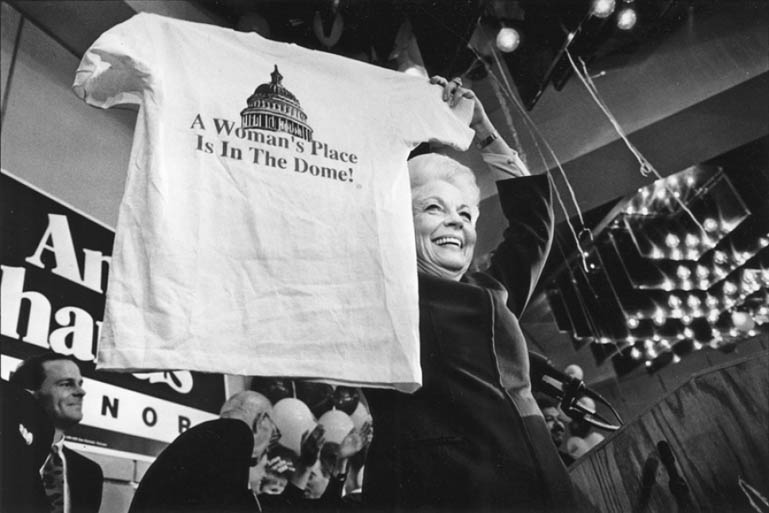
Molly Ivins on Ann Richards’ Legacy
As another Democratic woman heads for the governorship, the Observer shares an archival piece looking back at the last.
A version of this story ran in the November / December 2026 issue.
Editor’s Note: In light of the forthcoming entrance of another Democrat into the governor’s mansion—and because exactly two decades have lapsed since Ann Richards’ passing—we’re resharing our October 6, 2006, cover story.
It is Molly Ivins’ touching and candid obituary for her friend, the last Dem to hold the state’s top office—until Gina Hinojosa, that is. Here, the tribute has been condensed and lightly copyedited.
Ann Richards’ public life was mostly about gender. She was outrageous and courageous on behalf of women everywhere.
She was also a legendary campfire cook, a beautiful ballroom dancer (she did do everything Fred Astaire did, backwards and in high heels), she loved movies, was a bossy momma, just as good as at-the-moment quips as at telling great stories, a reluctant hunter (“first, you have to get up at four in the morning and dress from head to foot like a woody vine”), a great laugher, fine canoeist, former drunk, and first woman governor of Texas to get there on her own credentials.
In retrospect, it sounds almost easy. I believe if Ann had been born 10 years earlier or started 10 years later, she could have been president. But it’s easy to forget how firmly sexism ruled this culture.
When Ann first ran for statewide office in 1982, you could feel it: the start of a movement. Those women with big hair and big purses in Amarillo and Abilene flocked to hear her.
She said that running the treasurer’s office was just like balancing a checkbook “except more zeroes.” That quaint simile is in fact true. “Women are trained to detail, and we are expected to juggle a lot of balls at once,” she would say. In fact, motherhood is splendid training for politics. All good mothers know what to do when there’s two kids and one cookie, and all good mothers know what to do when there are two kids in the back seat hitting each other, each one of them claiming the other one started it. All political problems are merely variations of those two situations.

Her 1988 speech at the Democratic National Convention “made her a star overnight,” as they say. Ann had told me years earlier, “You always think Washington and New York are going to be so much harder. I mean, our friends here all think we’re wonderful, but they’re our friends, what do they know? Actually, if you can do it in Texas, you can do it anywhere.”
Ann’s opponent in the 1990 election was not [Republican] Claytie Williams but [primary opponent] Jim Mattox, who was meaner and smarter. He finally dredged up some allegation about cocaine use, and Ann, according to her campaign manager Glenn Smith, was paralyzed by it. Among other things, she was just embarrassed to have her parents hear about it. So she wound up not commenting, which turned out to set the model for pols being asked about “youthful indiscretions.”
The fall campaign teeter-tottered along, a real nail-biter with Claytie Williams helping out several times. Ann was running for “a new Texas,” as vapid a slogan as has ever been dreamed up, and Claytie, with his good ol’ boy racism and sexism—he never meant to offend a soul—kept defining “old Texas” in the most helpful way.

Ann won on the women’s vote: She carried it by almost 60 percent, including suburban Republican women.
She inherited a huge mess as governor. The state’s economy was in the toilet—oil at $8 a barrel and vast destruction left by the idiot follies of the S&L scandals. I don’t know that many of us who voted for her had expected Ann to spend most of her time helping General Motors, Apple Computer, and other dispossessed citizens, but she was quite proud of steering those deals where the state gives a company tax breaks, free infrastructure, etc. The state’s economy did grow slightly faster than the national average in those years, but we had not thought she would be cutting tax deals with big corporations.
The Observer was not ecstatic over her performance and, as I recall, rarely had much good to say about her. In the meantime, she also had to clean up the school funding mess and the prison mess (what good liberal builds 60,000 new prison cells?). She did put 14,000 beds into a prison alcohol rehab program. More than once she sat down with a circle of alcoholic convicts and said, “My name is Ann and I am an alcoholic.” (Bush later cut the program to 3,000 beds.)
Ann disappointed many liberals, but then, she was elected governor of Texas, not Sweden.
She ran again after four exhausting years, and it was fairly apparent she didn’t really want to do it. She had been working flat-out for the entire term. Although few people knew it, Ann had a form of grand mal epilepsy that could result in seizures: It was dangerous for her to get extremely tired. Ann pushed herself so hard and what she really needed was someone to force her to stop at the end of the day. But she felt under such pressure to run again—all those people who believed in her, all those women who were inspired by her.
One thing Ann delivered on was opening government to all the people. Her record of naming blacks and Hispanics to state boards and commissions, of working them into the bureaucracy so they rise at their own pace, has not been equaled since—not that Bush or Perry tried much.
Get the newsletter
The ’94 race was the full tide of Republican reaction. Newt Gingrich & Co. had taken Congress two years earlier, and it was God, Gays, and Guns. Naturally, rumors somehow spread about Ann and lesbians: She had appointed two openly gay people out of 800 or so appointments, but gay is gay. Ann had also said that if the Legislature passed a right-to-carry law, she would veto it. They did, and she did. The NRA put on a big push to convince her that we Texas women would feel ever so much safer if we could just carry guns in our purses. Ann said, when she issued her veto, “You know I am not a sexist, but there is not a woman in this state who could find a gun in her handbag.”
Had Ann been able to see just a little further into the future, she would have run like a racehorse. She really felt contempt for Bush and thought his ignorance and arrogance a dangerous combination. Depending on how liberal you are (and this magazine is lily-pure), you could also get mad about Ann’s lobbying career once she left office. When she was with the law firm of Verner, Lipfert, she actually lobbied for the tobacco companies. When I talked to her, it seemed to me more of a case of Ann getting paid for her political judgment, and she was right on every call she made. She told me the Senate had made a mistake by holding out for better than the attorneys’ general agreement with the tobacco companies, and she was right.
I’m glad she got to make money and take the grandkids on cruises and the girls down the Grand Canyon and all that good stuff. The most touching moment at a smaller service for Ann came from Bud Shrake, known as Ann’s “walker” when she was governor. Shrake is not likely to spill sticky sentiment across an occasion. He said simply, “She was the center of my life for 17 years. I loved her. A-men. A-women. A-Ann.”
I think what she said most often in her life was, “Idn’t it wonderful?”
You May Also Like

Texans Are Losing Their Democracy, School by School
In the exact system charged with instilling our civic values, voter input is being stripped out with each legislative session.

In Texas, the Glass Ceiling Shattered in a Gas-and-Groceries Cycle
Quietly—at least in the lead-up—voters ushered in a series of historic firsts.

Bobby Pulido, the New Scion of South Texas Democrats
The Tejano star ousted a two-term Republican incumbent, but now that the music’s over, what kind of congressman will he be?