‘Suicide by Cop’: How a Poorly Defined Term Shifts Accountability for Lost Lives
Austin officers killed an unarmed 17-year-old at a park last month in what the chief swiftly deemed "suicide by police." Some call the concept a type of "junk science."

In the early hours of July 24, someone placed a call to Austin’s 911 dispatch. The male caller told the operator he was looking out of his window and saw a teenager who may have had a gun. He wasn’t certain it was a weapon, but the person was “messing with his waistband,” the caller said. He gave the address of a community park in northeast Austin, one with a playground and a basketball court.
When police arrived only minutes later, the only person there was 17-year-old Anthoneil Williams II, a sociable, upbeat teenager, one who had never gotten in trouble with the police before. In body camera and surveillance footage of the incident, he appears to lift up his shirt and reach for his waistband.
The three responding officers all pulled their triggers—not just once, but enough times for at least two officers to empty their chambers and reload. They kept firing after Williams had already hit the ground. Austin-Travis County Emergency Medical Services was called to the scene after officers determined no one else was around, but Williams died on that playground at 4:25 a.m.
Afterward, the officers discovered there was no gun in Williams’ waistband—only a water bottle. They also found that Williams had placed the call.
Almost immediately following the shooting, Austin Police Chief Lisa Davis—who’s held the job since 2024—said, “All points are indicating that this was a suicide by police.”
That didn’t sit well with people who knew Williams or with some in the community. Cluren Williams (no relation), an activist whose own brother was shot by APD in 2017, called the characterization “irresponsible” and “dehumanizing.”
Chas Moore, founder of the Austin Justice Coalition, told the Texas Observer: “I just can’t believe that a 17-year-old Black boy had somehow become privy to a world of ‘suicide by cop.’”
Moore added that he’s concerned by the normalization of the concept that APD applied to Williams. “It just shouldn’t be a thing. This is the only profession in the world where you could, presumably, put yourself in a position to be killed by them,” he said. “There’s no suicide by Chick-fil-A server, suicide by a firefighter, suicide by teacher.”

The label “suicide by cop” is divisive. It’s a term that shifts the blame for a police shooting to the victim and insulates police from liability—and one that can fundamentally alter how officers respond to an emergency call. It’s become one of the major lenses through which people view and understand police shootings, but the frequency, the attributes, and even the validity of the concept are ill-understood.
There are indeed documented cases of people intentionally getting police to shoot them. In some instances, these people tell family members beforehand. Some leave suicide notes or tell 911 dispatchers what they’re about to do. But in most cases, the situation is less clear-cut, leading to a broader use of the label.
The Observer analyzed media reports of 100 incidents from the past 20 years that involved the ubiquitous but poorly defined theory. These included cases in which someone was shot and killed by police and cases in which someone was arrested or died by suicide after reportedly attempting or threatening suicide by cop. In the majority of cases, police are the ones using the label, and they’re not always clear about why they think it applies. In some cases, police say the victim told officers to shoot or had told dispatchers that they were suicidal—but not always.
In several cases, the theory was actually used as a defense strategy when a trial followed an altercation with police. If a person shoots at an officer in an attempt to get the officer to shoot back, that could convince a jury that a shooting wasn’t attempted murder but, rather, attempted suicide. On the flip side, officers may have an easier time justifying a shooting if they can argue they were forced into it.
The reported instances stemmed both from mental health calls and from reports of crimes. Williams’ shooting, which was never logged as a mental health call, took place while the Austin City Council debated and later approved the city budget, which included more than $1 million allocated to restructuring the local emergency dispatch, separating it from APD. (In Williams’ case, the 911 operator asked if the caller needed police, fire, EMS, or mental health services, and he answered “police.”)

Austin has had a dedicated mental health police unit since 1999, which trains officers to respond to mental health calls; some cities have moved away from police responses in these cases, though this model can struggle for lack of funding.
In more than a third of the analyzed cases, news stories confirmed the person had a gun. In several cases, the weapon was actually a replica or BB gun, or the police misidentified something like a water bottle.
There’s a reason that the label can be used in so many different circumstances: There’s no real consensus on what distinguishes suicides by cop from other police shootings. Some critics have dubbed it “junk science” and compared it to debunked concepts like “excited delirium,” the purported spontaneous death of people being restrained by police.
“Suicide by cop draws on real-world examples—in this context, of people who want to die at the hands of police—and manipulates the definition to encompass a much larger category of cases,” wrote a University of California, Berkeley law professor in a 2025 article in the California Law Review.
The term was reportedly coined by a police officer-turned-psychologist in the 1980s, and in the two decades following, several studies purported to further refine the concept. These researchers determined that anywhere between 10 percent and a third of police shootings each year were actually suicides by cop. But, in 2026, there is no national database that tracks this highly subjective label.
In a 2014 bulletin, the FBI defined suicide by cop as “a situation where individuals deliberately place themselves or others at grave risk in a manner that compels the use of deadly force by police officers.” The various studies try to identify characteristics of suicides by cop: Someone seems to intentionally seek out danger, they have or appear to have a weapon, or they escalate the situation when police arrive.
But all those characteristics could be at play in any police shooting where the victim didn’t want or intend to die. So police end up making the determination of someone’s suicidality, which mental health professionals note is tricky. In a 2020 article published in a journal by the American Psychiatric Association, the authors write: “When evaluating a patient, it is impossible to predict whether that person will take his or her own life.”
Until recently, training for how to deal with a potential suicide by cop incident didn’t exist. In 2019, the national Police Executive Research Forum (PERF) created the first training guide on the subject, with the imperative: “Responding to a possible SBC call: Your goal is to resolve it so that everyone goes home safely.”
Officers are instructed to take cover, “make small requests” rather than “bark[ing] orders,” refrain from pointing their guns, and be patient.
Chuck Wexler, executive director of PERF, told the Observer that even after decades of hearing the term suicide by cop, he wasn’t clear on what it meant. After researching the theory and publishing the guidelines, he said the goal of using the label is to “prevent tragedies” and better understand police shootings.
“The term that we use is to explain the set of circumstances, but in no way to diminish the tragedy,” Wexler said.
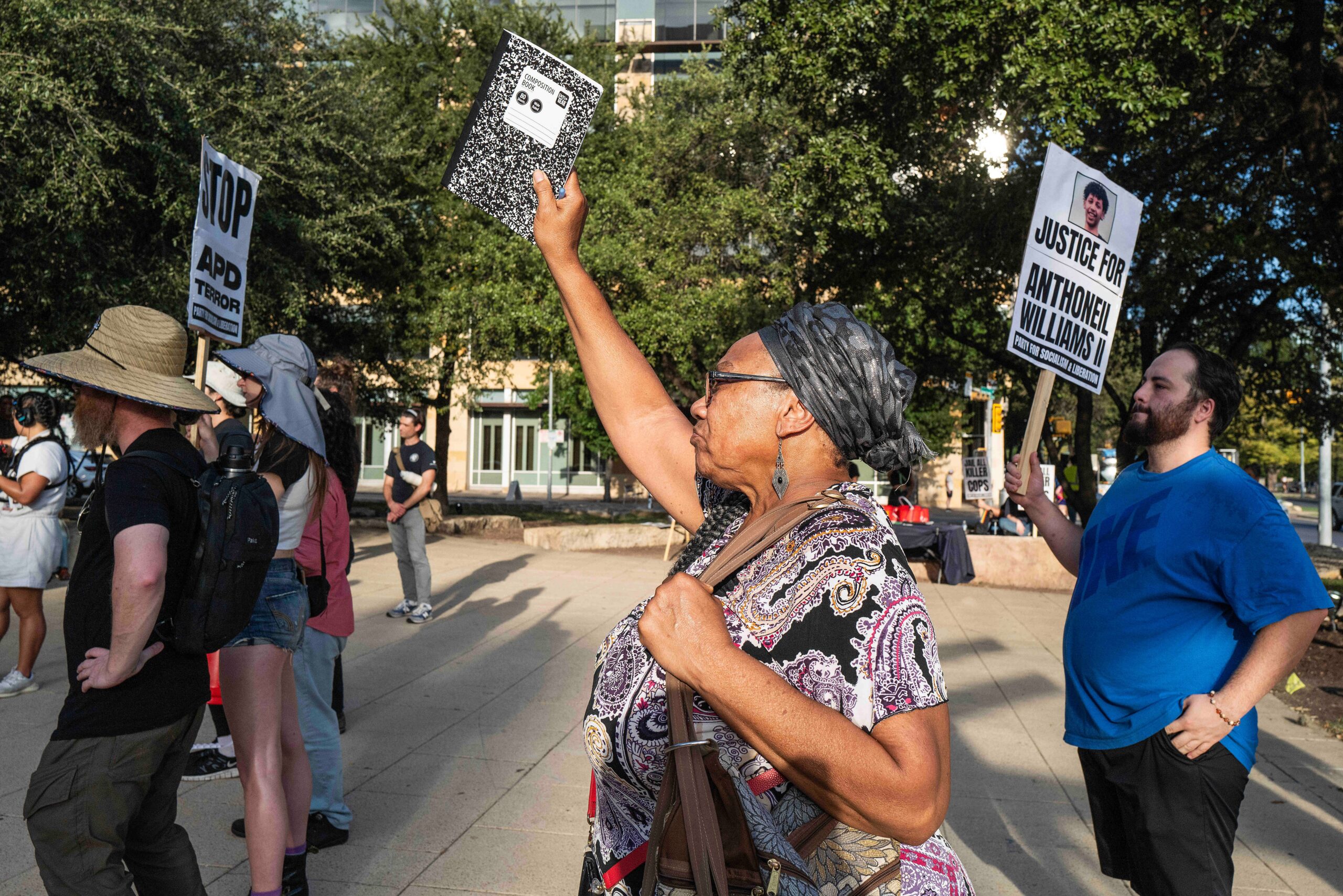
After Williams’ death, protesters—including his school friends and his father—interrupted a city council meeting, rallied outside city hall, and entered the Travis County District Attorney’s Office, where they chanted: “Jail killer cops.”
To reporters, 16-year-old former classmate Ameer Alogaili emphasized how he’ll remember his friend: “a little kid at a park” who could always “put a smile on everybody’s face.”
You May Also Like
When Local Police Collaborate with ICE, Children Pay the Price
I know exactly what message the recent deportation of an Austin mom and her 5-year-old sends to kids. They learn that calling 911 is dangerous.
A Palestinian American Was Stabbed in ‘Bias-Motivated’ Attack in Austin
Police are investigating the assault as a potential hate crime as advocates call for local leaders to back a ceasefire in Gaza.
Mental Illness Shouldn’t Land You in Jail
Up to 40 percent of the people who end up behind bars in Travis County are in crisis. Diversion offers better options.