School Closures Are Escalating Across Texas. ‘It’s Not a Local Failure.’
State funding and policy have fallen short, advocates say, and the consequences are not confined to your backyard.

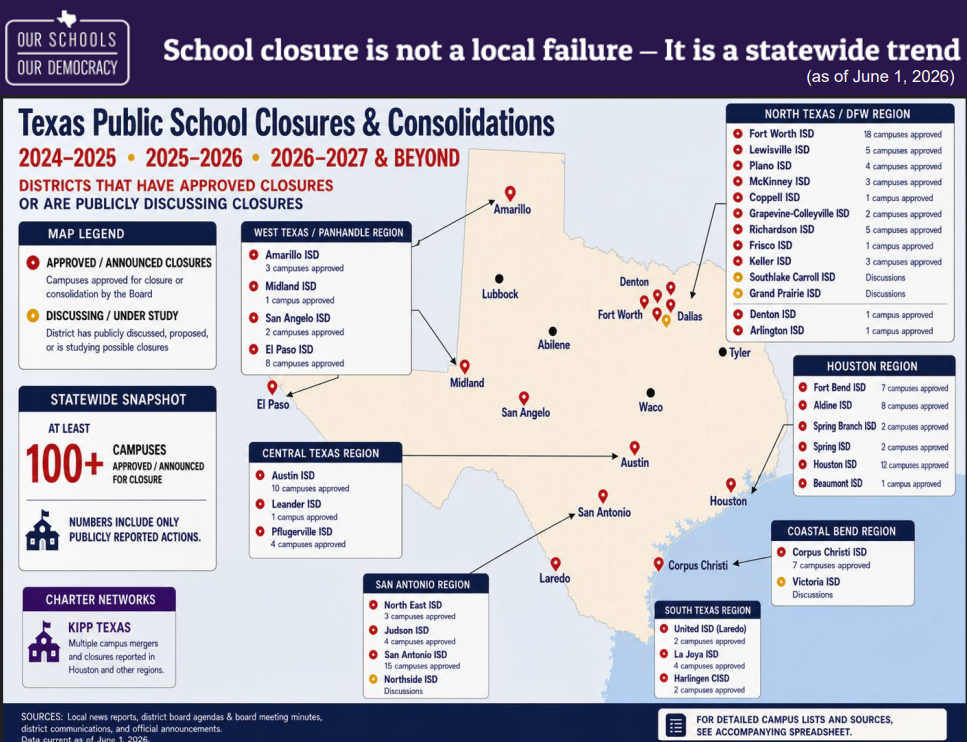
At least 135 public schools have closed or have been approved to close all across Texas since late 2023, as districts face budget crises amid state funding shortfalls, according to data gathered by the public school advocacy organization Our Schools Our Democracy.
Carrie Griffith, executive director of the Austin-based nonprofit, said every region of the state has been impacted by school closures. “It’s not specific to urban or rural areas. … It’s not confined to any sort of racial or ethnic breakdown.” Griffith said. “That is why we say it’s not a local failure; it’s a statewide trend.”
The number of Texas public schools facing closure more than doubled from 2024 to 2025, rising from 22 to 50, the nonprofit’s data shows. And in the first six months of 2026, Texas school districts have voted to close even more schools—at least 55—than last year.
Using school district board minutes and news reports, Our Schools Our Democracy found that closures spanned the state. The North Texas region had the highest number of schools—around 45—that have been or will be closed. Some closures are happening in districts that have been taken over by the state, including in Fort Worth, Houston, and Beaumont, according to a list the nonprofit continues to update. The Fort Worth Independent School District (ISD), which is now operating under the state’s appointed board of managers, recently expanded its list of pending closures to include 19 campuses by June 2029.
School funding is tied to student attendance, which has fallen in many public school districts around the state. Griffith believes that, apart from the issue of lower birth rates, charter schools and the new private school voucher program are also siphoning students away from public schools.
The Houston area has 32 campuses and the San Antonio area has 23 campuses in the list compiled by the nonprofit.
Bobby Blount, the president of the Bexar County School Board Coalition and a Northside ISD board member for 27 years, said school districts’ growing budget deficits, in part linked to a lack of state funding, are a major factor leading to increased campus closures.
Before a modest increase approved in the 2025 legislative session, lawmakers last increased investments to public schools in 2019. For a while, federal money tied to COVID-19 relief kept school districts afloat. But those funds dried up even as inflation and declining enrollment in public schools increased school deficits. Then, in 2023, Abbott obstructed an increase for school funding when lawmakers initially rejected school vouchers. More funding came only after vouchers were approved in 2025.

Griffith said she thinks the voucher program will accelerate the number of neighborhood school closures, which have already been affected by charter school expansions.
“Just in this most recent biennium, the state paid $10 billion to charter schools, and that’s at a direct expense to the money going to public school districts … and now districts are also bracing themselves for the anticipated impact of losing students to private schools [through vouchers],” Griffith said.
Even after lawmakers in 2025 passed what they called a “historic” $8.5 billion school funding package, it wasn’t enough to make up for prior years of shortfalls.
The Legislature raised the basic allotment, or the primary per-pupil funding, by $55, but it would have had to increase it by more than $1,300 just to keep up with inflation since 2019, according to Raise Your Hand Texas, a public policy group. Texas ranks in the bottom 10 states for average public education spending, according to data from the National Education Association.
Instead of going to the basic allotment, which would have allowed school districts to use the increased funding as they needed, most of the new funding was earmarked for specific items. Kelly Rasti, the associate executive director of the Texas Association of School Boards, said the funding did not address the needs of many school districts because of the restrictions.
“Increasing the basic allotment allows for school districts to direct the increased funding to what their local needs are,” Rasti said. She added the bill also created new spending requirements for districts.
“How is it possible that this remarkable amount of money was invested into public schools and they’re still closing and they’re still adopting deficit budgets? It’s because the majority of that money was not directed in a way that schools can plug their existing holes.”
You May Also Like
A Texas Austerity Crisis Is Playing Out City by City, School by School
Texas' local governments are facing growing fiscal pain. What’s that mean for the 2026 elections—and the 2027 session?

More Money than Greg
A blue wave may be coming, but the governor's ever-growing campaign warchest casts a long shadow over Texas elections.
Abbott’s Bail Crackdown Meets Mixed Fate in Texas House
The lower chamber approves key pieces—but only pieces—of the governor's pretrial incarceration agenda.