
Editor’s Note: This is part two of a two-part series supported by the Pulitzer Center and the Ida B. Wells Society Investigative Reporting Fellowship. See part one here. (Leer en español aquí.)
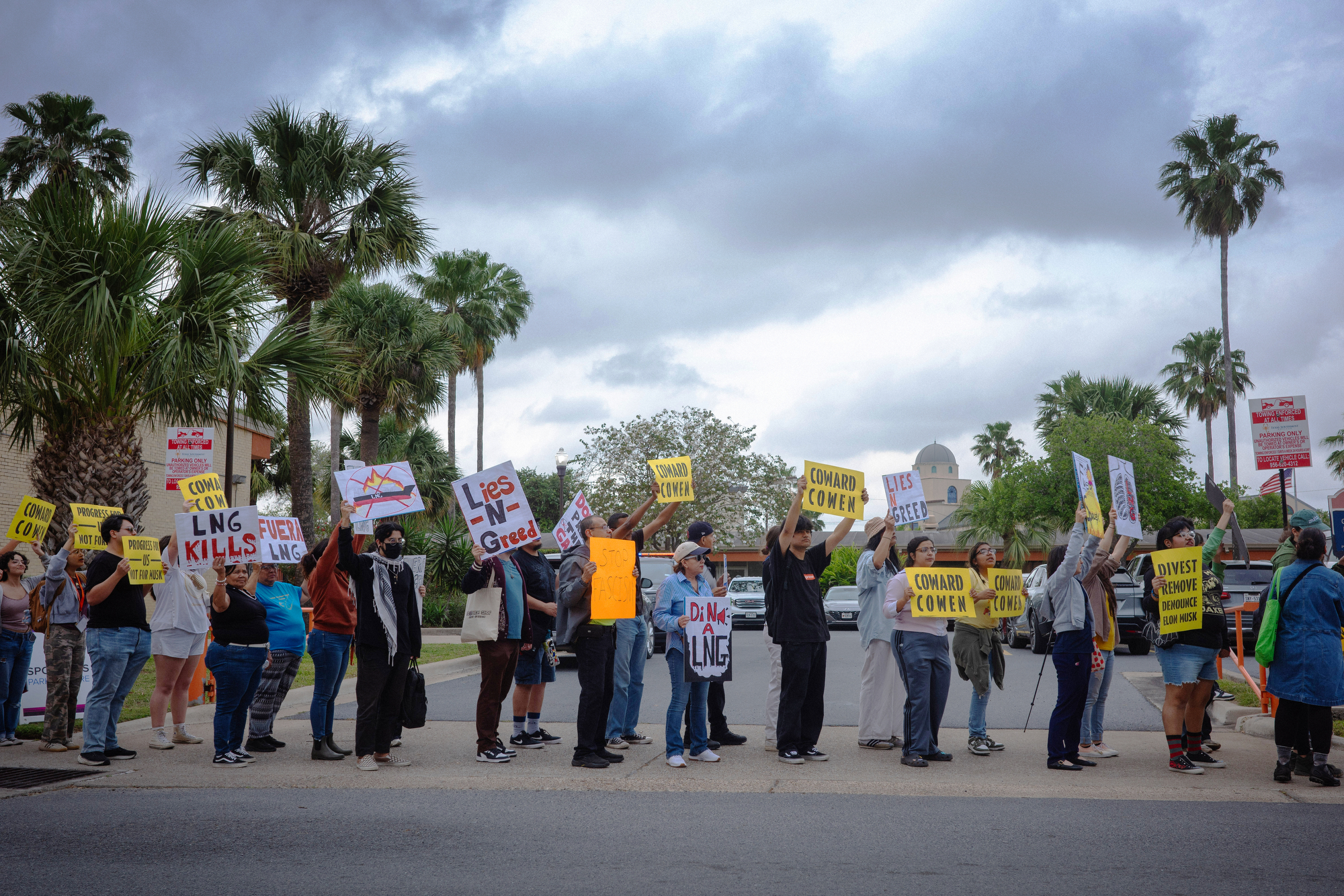
On a balmy, overcast afternoon in late March 2025, a crowd gathered outside Texas Southmost College’s auditorium in downtown Brownsville. With them came signs, many of them directed at the city’s mayor, John Cowen, who was giving the annual “State of the City” address inside.
“Brownsville is at the edge of its future,” Cowen told attendees. The mayor, who also serves as president of his family’s international logistics company, headquartered in the border city he now leads, described various industries operating, or soon to be operating, in the area. Some prominent corporations sponsored the event, including Houston-based NextDecade, the company behind the gargantuan gas export project Rio Grande LNG.
The phrase “edge of the future” echoed the “New Space City” sentiment first promoted by the previous mayoral administration and inspired by Elon Musk’s nearby SpaceX launch site. The boosterish idea is codified in Brownsville’s newly expanded slogan: “On the border, by the sea, and beyond.” Outside among the protesters, however, local industry expansion, especially in liquefied natural gas (LNG) exports, was not seen as an economic driver but an existential threat.
“Brownsville cannot keep selling us out to these toxic polluters,” said Josette Cruz Hinojosa, an organizer with the South Texas Environmental Justice Network and onetime candidate for the Port of Brownsville’s board of commissioners. “The city has continued to fail us, and the city is endangering us directly—endangering our children and their future.”
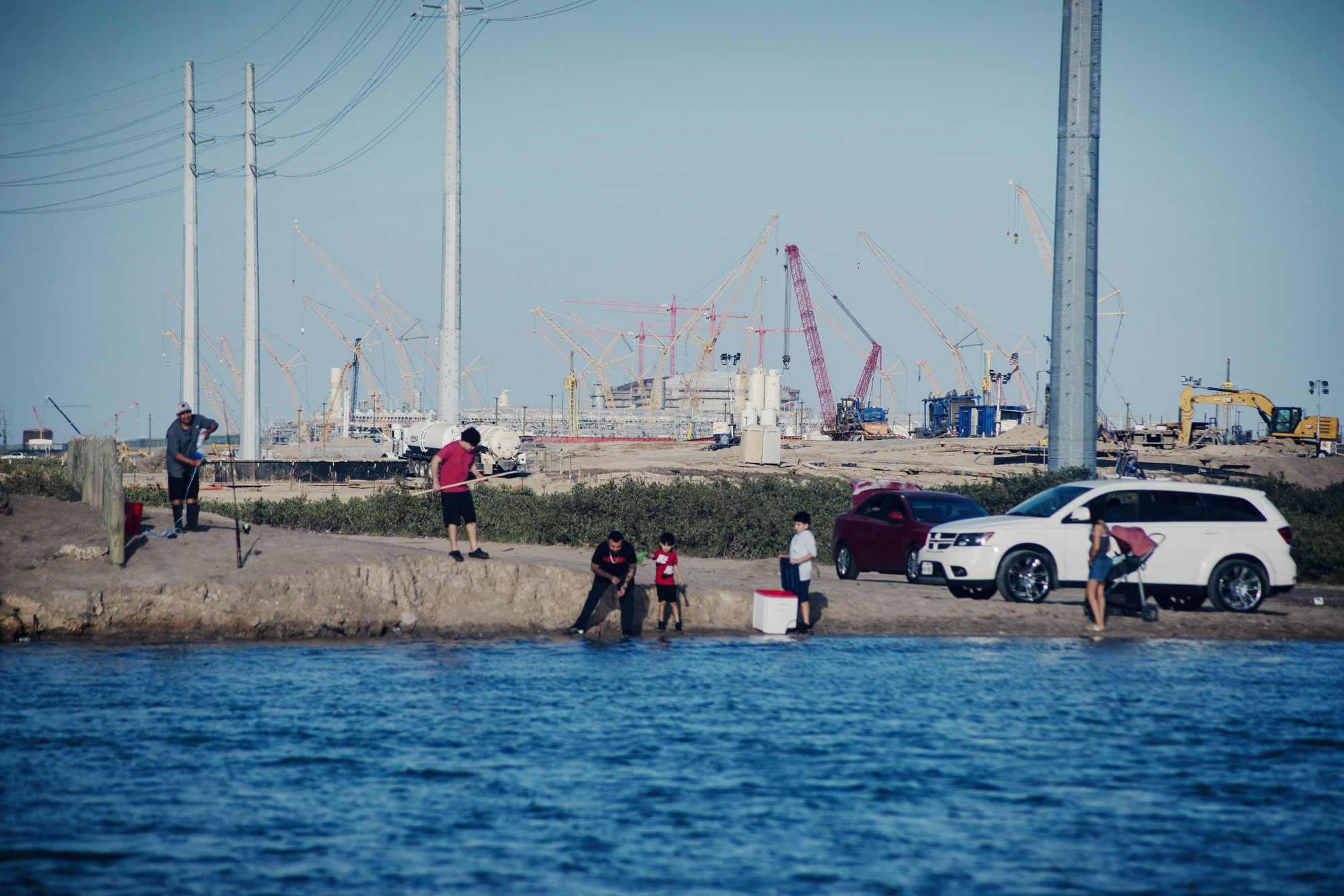
Elected officials with the city and surrounding Cameron County have incorporated Rio Grande LNG, under construction 12 miles east of Brownsville and expected to be one of the country’s two largest such facilities by export volume, as a core part of an area-wide effort to remake the Rio Grande Valley—the region of about 1.4 million mostly Latino residents at Texas’ southern tip—into an international corporate hub. Officials rooted in Brownsville, population 192,000 with a 25 percent poverty rate, have promoted the export plant as a major source of jobs and related economic activity. NextDecade promises to provide at least 5,000 construction jobs and 437 permanent positions. For this, Cameron County handed the company a 10-year, $373 million tax break (about 1.5 times the county’s annual budget).
Meanwhile, officials nearer the project site in the environmentally sensitive Laguna Madre area—home to the much smaller communities of Port Isabel, Laguna Heights, Laguna Vista, Long Island Village, and South Padre Island—have opposed the facility over the past decade. Local governments, Port Isabel’s economic development corporation, and even the local water utility signed resolutions opposing LNG projects as companies started signing leases along the Brownsville Ship Channel. The area’s lone school district rejected tax abatement requests for gas facilities.
As the Texas Observer reported in part one of this series, the Laguna Madre area, which currently depends on tourism and fishing, has cause for concern. Political and business leaders elsewhere along the Texas Gulf Coast and into Louisiana have bent over backward to bring in LNG; in the years since, they’ve seen explosions, air pollution, gutted shrimping income, and transformed neighborhoods and natural spaces. As one lifelong resident of the Louisiana coast put it: Her hometown’s “never going to be the same,” and for the people of the Laguna Madre area, she said, “Your hometown’s not going to be the same neither.”
Yet Brownsville-area officials have ignored these risks along with the hyperlocal opposition. Now emails and documents obtained by the Observer reveal how this posture may have been influenced by an extensive and yearslong lobbying effort by NextDecade, with Cameron County and the city being in regular contact with the company as the firm worked through various legal setbacks. The records also show that NextDecade and these governments already have several public-private partnerships in the areas of emergency services and community relations, going beyond the tax abatement that the county granted the company in 2017.
“If you want to put it succinctly, they’re a bunch of mamones,” said Jared Hockema, Port Isabel’s city manager and a local Democratic politico, after reviewing the Observer’s findings showing the contacts between Brownsville and Cameron County officials and NextDecade. “That’s exactly what they are, doing something like this—selling out your neighbors.”
In 2022, NextDecade’s then-chief lobbyist, David Keane, approached Brownsville City Manager Helen Ramirez via email to join the company’s Community Advisory Board (CAB). This advisory board would engage in “two-way communications between the community or communities and the Rio Grande LNG project,” he wrote.
Ramirez joined as a permanent member of the group, which is almost entirely made up of people who publicly support Rio Grande LNG, including the highest elected officials and administrators from the county, the City of Los Fresnos, the Port of Brownsville, and the City of Brownsville, along with several NextDecade executives. Email invitations for the board meetings show additional members, including staff from the Brownsville Chamber of Commerce, SpaceX, and more.
NextDecade claimed it created the CAB for the company to “become aware of any community concerns and address them.” But the group was also instrumental in NextDecade’s strategy to use elected officials for leverage when Rio Grande LNG faced opposition.
In 2023, as part of a long-running legal battle over the plant, all but one permanent member of the board—Port Isabel’s police chief, Robert Lopez—sent a letter to the Federal Energy Regulatory Commission (FERC) saying the regulator was taking too long to reapprove Rio Grande LNG after it had faced a setback. FERC was analyzing the plant’s potential environmental justice impacts for a second time, prompted by a lawsuit from Port Isabel. These letters were ghostwritten by NextDecade, as previously reported by DeSmog.
Prior to sending those letters, as shown in emails and calendar invites, Keane met repeatedly with Cameron County officials, who were among the senders. A few months later, NextDecade got enough financial backing to start construction of the Rio Grande LNG facility, celebrating the milestone at a “stakeholder reception” in Brownsville in August 2023.
“He’s written letters on our behalf. He’s been a supporter when we needed him,” Keane said of County Judge Eddie Treviño before introducing him to speak at the event. “He’s probably sorry that he gave me his cell phone number.” NextDecade broke ground on the LNG site later that year.
In May 2024, Keane asked the CAB to turn out at a commissioners court meeting to support amendments to NextDecade’s tax abatement. That August, the company called on some CAB members to “stand with RGLNG” after the project lost its FERC authorization—because of a lawsuit from Port Isabel residents, the Carrizo/Comecrudo Tribe of Texas, the City of Port Isabel, and the Sierra Club. NextDecade wrote or edited testimonials, op-eds, and video scripts for these elected officials that were published on the company’s website and in local news publications.
That same month, and into September, NextDecade’s legal team guided City of Brownsville attorney Guillermo Treviño in filing an amicus brief as part of the company’s appeal, emails show. NextDecade’s legal counsel suggested arguments, a template for the brief, and how to properly file it. “It will be interesting to see what response the petitioners come up with,” Treviño wrote to Keane.
“Thank you for your continued support,” Matt Schatzman, NextDecade’s CEO, wrote in a note to Cowen after the city filed its amicus brief. “We will get through this, and persevere!”
In an email to the Observer this April, Treviño said that “NextDecade’s legal consultants did not participate in the drafting” of the brief and that “The majority of it was written by me” with input from others unaffiliated with NextDecade.
Brownsville and Cameron County officials continued to frequently confer with NextDecade representatives, emails show, with the latter repeatedly thanking the former for letters and public support. This included NextDecade helping Cameron County edit a press release announcing that the Rio Grande LNG project had won a state economic development award. In November 2024, calendar entries show that NextDecade hosted lunch and dinner meetings with Brownsville and Cameron County officials and representatives of the Japanese financier Mitsubishi UFJ Financial Group, which is a financial adviser for Rio Grande LNG.
In February 2025, the Cameron County Commissioners Court invited a council member, Joe Ricco, and the mayor, Patrick McNulty, both of South Padre Island—one of the Laguna Madre-area towns that has opposed LNG—to speak about expanding their city’s convention center. The agenda for the commissioners meeting specifically included an executive-session item to “confer with commissioners’ court legal counsel regarding possible legal issues with the South Padre convention center.”
During the executive session, Ricco told the Observer, Cameron County Commissioner David Garza asked the Padre Island officials if they were going to sign a “letter of support” for Rio Grande LNG if the county backed the convention center expansion. The Island elected officials said they wouldn’t.
When asked about this, Garza did not confirm or deny whether he asked the officials to support the LNG project, but he said that a support letter from South Padre Island during the time frame Ricco said this exchange occurred “would not have altered the outcome, as LNG was already established in the county.” When asked again whether he asked the officials if they were going to support the LNG project, Garza did not respond. Ricco reiterated that the exchange occurred when the Observer showed Ricco the commissioner’s response.
The agenda and minutes for the February 11, 2025, meeting made no reference to discussion of the LNG project with the city officials. “On its face, assuming the council member’s account is correct, it does raise serious questions about whether the discussion in executive session went beyond what’s allowed under the Open Meetings Act,” said Jim Hemphill, an Austin attorney on the executive committee of the Freedom of Information Foundation of Texas who separately advises the Observer on libel matters.
In November 2025, Ramirez, Cowen, and several city and Brownsville Chamber of Commerce staff took a lobbying trip to Washington, D.C. The group, which included senior employees of NextDecade and Bechtel, the company constructing the LNG plant, met with Senators Ted Cruz and John Cornyn, as well as Valley Congressman Vicente Gonzalez, all of whom support Rio Grande LNG. The trip and a private dinner were partly sponsored by NextDecade. The chamber, which designated NextDecade its 2025 “Member of the Year,” declined to disclose how much NextDecade paid for the trip when asked by the Observer.
Like other LNG companies up along the coast, NextDecade is building an omnipresence locally, sponsoring events throughout the Laguna Madre and Brownsville areas, including fishing tournaments, beach cleanups, and Port Isabel’s annual shrimp cook-off. NextDecade also now regularly hosts “LNG demonstrations” at area schools, including in Point Isabel ISD, the same district that rejected the company’s tax abatement request.
As the LNG plants in other Gulf communities expanded, so did their political and cultural power among elected officials, local chambers of commerce, and emergency responders. NextDecade is no different: The company agreed to fund the salary of a Cameron County deputy fire marshal for four years. It also gave the City of Brownsville nearly $1.2 million to cover the cost of a fire truck the city bought in 2024. According to a cost-sharing plan acquired through a records request, NextDecade will also pay for training some of Brownsville’s firefighters to respond to emergencies at the Rio Grande LNG facility. The company will additionally pay, the plan says, for any city fire and emergency services that the plant receives once it starts operating.
Cowen and Ramirez, the latter of whom resigned from the city in December 2025, declined to comment for this story.
When meeting with local officials, NextDecade representatives downplayed the negative effects that Rio Grande LNG would have on the surrounding area, saying the company would mitigate whatever issues came up, according to officials familiar with those conversations. This included so-called carbon capture, removing carbon during the liquefaction process and injecting it into a well so that it would not go into the atmosphere. NextDecade claimed this would remove up to 90 percent of the yearly carbon emissions from Rio Grande LNG’s operations.
This technology would help make the plant the “greenest LNG project in the world,” as the company has touted. But, in 2024, a year into constructing the plant, NextDecade pulled its FERC application to incorporate carbon capture, saying the technology wasn’t “sufficiently developed.” The corporation still says Rio Grande LNG will provide “low-carbon” energy but has yet to specify how or apply for a related state permit.
In its latest environmental assessment of the Rio Grande LNG project, FERC said that NextDecade was considering a carbon storage site in Kleberg County, about two and a half hours away from Port Isabel. The company’s most recent investor presentation said that it’s “exploring a potential [carbon capture storage] project” but makes no other mention of its development.
With plans to expand beyond its initial projected size and no carbon capture system in place, Rio Grande LNG’s greenhouse gas output would be even larger than what FERC first analyzed in 2019. And even if Rio Grande LNG removes some carbon, it would remove only the emissions from one part of the liquefaction process: It would not remove other pollutants or reduce how much carbon is leaked during transport and released by the fuel’s burning.
Emails show that NextDecade representatives told Cameron County and Brownsville officials in August 2024 that the company had pulled the carbon capture system from Rio Grande LNG, but no officials directly responded. County Judge Treviño told the Observer last June that he had been looking forward to the system being a part of the project and he hoped it would return.

The first construction phase of the facility remains underway. If Rio Grande LNG builds out to 10 “trains”—the term for the machines that chill and liquefy the gas—as NextDecade has now indicated, the plant will export 60 million tons of gas per year, potentially sending more than a dozen ships per week through the Brazos Santiago Pass, where the channel meets the Gulf, creating hours of delays for other vessels.
Rio Grande LNG’s expansion beyond its initial plans was mentioned specifically by the City of Port Isabel when it again sued FERC in December in the D.C. Circuit Court, the same federal court that had canceled Rio Grande LNG’s authorization by the regulator earlier last year. The lawsuit came after FERC had approved the project for the third time, in September, shortly after the company completed a court-ordered supplemental environmental impact statement.
The city, the South Texas Environmental Justice Network, the Sierra Club, and Earthjustice said in the December lawsuit that FERC had again failed to accurately measure the air pollution impacts of Rio Grande LNG, nor had the regulator incorporated the project’s expansion plans into its analysis. Nathan Matthews, senior attorney for Earthjustice and the lead attorney on the suit, said it could take up to a year for the court to rule.
FERC noted in its 2019 analysis that ship traffic, as then projected, would have “permanent and moderate” impacts on local fishing industries that use the Brazos Santiago Pass, including shrimpers, who are already struggling to remain in business.
“We’re in a sensitive state as it is, and any little thing to agitate that just makes it worse,” E.J. Cuevas, who runs the shrimping company Cuevas Trawlers in Port Isabel, told the Observer. Shrimpers and other vessels already must coordinate with the dredge ships that are deepening the channel to fit LNG tankers, a precursor for what’s to come if the hulking ships regularly start making their way through.
Regardless of whether Rio Grande LNG reaches 10 trains, it will be a massive operation, requiring an equally large emergency response if an accident occurs. Some Laguna Madre-area cities aren’t satisfied with how the company will respond to a disaster, if one happens. Speaking on background to discuss confidential material, three local officials told the Observer that the plans are inadequate and that, even with industrial fire training, local fire departments are unequipped to handle a disaster akin to a 2022 LNG explosion that occurred up the coast in Freeport or worse.
“Even if Brownsville Fire responds out there, they’re going to need multiple agencies to respond,” one local emergency services official in a nonelected position told the Observer. “They can send every damn truck that they have. It’s not going to be enough.”
A glimpse of what could happen was seen after SpaceX’s Starship, which launches 6 miles as the crow flies from the LNG project site, exploded in the middle of the night last July. The Brownsville Fire Department held back from responding to the blaze as 911 calls flooded the dispatch line. Nobody was hurt, yet the explosion overwhelmed the city’s emergency services for hours.
There have already been generator fires at the Rio Grande LNG site, along with car accidents outside of it, which TxDOT data obtained by the Observer shows have doubled in the area since 2023, the year construction started. Occupational Safety and Health Administration (OSHA) reports also show that at least two serious workplace accidents have happened at the location.
FERC’s most recent analyses of the Rio Grande LNG plant say the risk of explosions or other disasters is “extremely low” because of the mitigation precautions it requires, including spill containment and emergency shutdown plans.
Meanwhile, Laguna Madre-area residents have gotten a relatively paltry portion of the jobs created so far by the plant. The company has said in emails to elected officials that 70 percent of the project’s construction employees are “local”—which it defines as people from zip codes within 100 miles of the facility, a radius wide enough to encompass the more-populous McAllen metro area in neighboring Hidalgo County. From mid-2023 to mid-2025, internal reports and emails indicate that NextDecade maintained an average of around 1,400 full-time-equivalent jobs at Rio Grande LNG, with about 50 of these coming from Port Isabel. Brownsville, along with Mission and Edinburg—two cities in the McAllen metro—had around 790 combined. There was no current count of employees or breakdown of their origins in the documents reviewed by the Observer.
NextDecade did not respond to repeated inquiries about current local employment numbers at the site. The Texas Workforce Commission denied requests related to the company’s employment records.
At least six of every 10 people who live in the Laguna Madre area work on the fishing boats or in the stores, restaurants, hotels, and bait stands that both locals and tourists frequent year-round, according to Census data. These industries, in some form or another, rely on the beaches and bays that surround them, along with interconnected wetlands and the brush beyond. Though FERC says there won’t be “significant” impacts to these industries, many residents aren’t believing it. Nor are they believing that Brownsville-area officials would be as supportive of LNG if the plant was closer to them.
Mary Angela Branch, a Port Isabel resident and member of SaveRGV, an organization that opposes SpaceX and LNG in South Texas, is one of the doubters.
“They’re not seeing it. They’re not smelling it. They’re not driving home to it,” Branch told the Observer. “Maybe if they came out to [South Padre] Island and they had to wait a little bit because the tanker was coming in, or sitting in traffic on [Highway] 48. But that didn’t matter. They didn’t even think about that. And that’s so minuscule compared to how we are impacted by it.”
Bechtel has already cleared nearly a thousand acres of ecologically critical clay dunes called lomas—along with whatever archaeological artifacts may lie beneath them—plus thornscrub and other native flora, replacing them with cranes, storage tanks, and the trains that will liquefy the gas. NextDecade has established a conservation area in Brownsville to ostensibly compensate, but similar to destroying old-growth forest, the erasure of wetlands is often practically irreversible. It would take decades for the area to return to a state similar to that from before the construction, if the plant were to ever cease operating.
Across the road from the Rio Grande LNG site is the Bahia Grande Unit of the Laguna Atascosa National Wildlife Refuge, a tangible reminder of what the land looked like before the plant and even before Highway 48. In 2005, a multi-agency project that included Cameron County rerouted water from the Brownsville Ship Channel to begin filling the empty tidal basins of the refuge, marking one of the largest estuary-restoration projects in the United States. A year later, the U.S. Fish and Wildlife Service presented a National Conservation Award to the Cameron County Commissioners Court for its role.
But an environment-forward county commissioners court belongs to a bygone era. Hockema, the Port Isabel city manager, said past county leadership rejected projects that were environmentally damaging, such as a landfill in Los Fresnos and oil drilling in Boca Chica Beach (where SpaceX now looms).
“Cameron County is the one that led the project to restore the Bahia Grande [wetlands]. That’s the irony of all this,” Hockema told the Observer. “And then now they’re destroying it. It’s crazy.”
Hockema called the county’s focus on new industry myopic, and he said economic development shouldn’t take precedence over public safety, quality of life, or the environment.

County Judge Treviño, meanwhile, sees his responsibility as the county’s highest elected official differently. “We view our goal as a county, as the largest local government, to work with entities, small and large, to help them accomplish and reach their goals,” Treviño told the Observer.
When asked about Port Isabel’s opposition to the project, he said the city stood to benefit the most from Rio Grande LNG because employees would stay, eat, and spend money in town. Hockema partly disagreed, noting that while Port Isabel does get some business from workers shopping and eating in town, most employees working at Rio Grande LNG don’t live in the area.
Treviño said the project amounted to the county taking a chance on bringing more jobs to the area and alleviating its poverty rate—and that NextDecade needed to be a “good neighbor” in doing so. He said he didn’t believe that Rio Grande LNG would be as environmentally destructive as the “naysayers” predict. “We got to be worried about tomorrow,” Treviño said. “If you don’t get up and take a swing, you’re never going to get a hit.”
He continued, “but the concerns are valid, and they should always be on top of mind, making sure that these industries, small and large, don’t have a negative, permanent impact on our local environment.”
An October 2025 analysis of public emissions data by the Environmental Integrity Project found that every operating LNG facility nationwide has violated its pollution limits. Five facilities have violated the Clean Water Act, including Corpus Christi LNG, which is about three hours from the Laguna Madre area and, as of now, the closest operating gas export facility.
Even with only six trains, four fewer than NextDecade is planning to develop, Rio Grande LNG, FERC says, would emit about 6.5 millions tons of greenhouse gasses and tens of thousands of pounds of air pollution a year. That’s the same greenhouse gas emissions that would come out of about two coal plants, according to the Environmental Protection Agency’s greenhouse gas calculator.
Treviño said he trusted that NextDecade has the most current technologies and safeguards to prevent accidents like Freeport LNG’s 2022 explosion, though he added that the county would watch the company closely.
“Things can always change, but I think, both short and long term, this is going to be a net-positive thing. That’s what I’m praying for.”
NextDecade expects to start producing LNG at the plant in 2027.