
The Texas Ocelot in a World ‘Propelled Toward Algorithms and Bottom Lines’
Karen Olsson’s latest novel, about a biologist and the rare cats, marks the third installment in a trilogy of blighted idealism.
Neither tacos, nor bluebonnets, nor crooked politicians are unique to Texas. However, ocelots—spotted wild felines—just about are. Although they can be found south of the border, Texas is the only state in the country (except for very rare individuals found in Arizona) that is home to ocelots, and here only in the state’s far southern thornscrub. Fewer than 90 ocelots inhabit deep South Texas, and their numbers are dwindling.
In Karen Olsson’s third novel, Dear Thorns, a forty-something conservation biologist named Lora has spent seven years working at Tangled Lake, a fictionalized version of the Laguna Atascosa National Wildlife Refuge, stalking and studying the area’s elusive ocelots. That means setting traps for them and, on the rare occasion in which one is captured, fitting it with a GPS tracker before releasing it back into the wild. Every now and then, she gives public slide lectures about the vanishing species she is intent on saving. “Sometimes,” writes Olsson, “Lora wondered whether she was anything more than a witness to extinction.” Those who care about ocelots are also an endangered species.
Get the newsletter

Olsson dedicates her book, out November 3 from Astra House, “For Texas,” and it is set in a desolate southern part of the state where the closest metropolis is Harlingen, population 72,000. Her first novel, Waterloo, was a canny send-up of a capital city much like Austin, which was in fact originally named Waterloo. Her second novel, All the Houses, was set in another capital, Washington, D.C. A former editor of the Texas Observer, Olsson returns now to a scraggy landscape that Lora, an outsider who grew up in the Northeast, has learned to love: “It was strange, how devoted she’d grown to this rugged, abused land.” A quirky old rancher confides to Lora how as a young man he had moved to New York but eventually made his way back home. “I’ve been arguing with Texas my whole life.” In this novel, Texas, despite its unforgiving climate and prickly, unlovely vegetation and people, wins the argument.
What drives the story is Lora’s passion for observing and preserving vulnerable wildlife. Olsson, who shares her knowledge of the distinctive flora and fauna of South Texas, captures the “stillness, waiting, patience” that are obligatory in the daily tasks of a professional naturalist. Tracking creatures out in their thorny habitat induces a kind of ecstatic state that is independent of practical purposes. Lora lives alone in a shabby residence at the wildlife refuge and can count on assistance only from a couple of young interns. Her desire to study ocelots on nearby private lands is thwarted by local ranchers’ automatic mistrust of government agents. But the serpent in her rural paradise is her boss, Greg Granger, who is not only indifferent to the plight of ocelots but also hatches a plan to privatize their conservation. By renting out cabins to hunters, the wildlife refuge’s director would turn Tangled Lake into a commercial enterprise, while outsourcing the protection of ocelots to local ranchers.
Lora is of course appalled by this betrayal, which plunges her into a midlife crisis. Granger’s scheme would mean either losing or else dramatically redefining her job as conservation biologist. More fundamentally, it seems to her capitulation to the commercial forces that are obliterating the natural world. She frets over how “it was becoming harder and harder to do things that didn’t generate a profit, even if they were helpful and decent things to do, the profit motive just kept urinating all over everything, marking more and more territory, and all that piss, all the degradation, whether it was the development that had imperiled the ocelots to begin with, or the lack of support for the kinds of bigger, more ambitious conservation projects she wished she could work on.”
Lora thinks back to happier times, when, in a romantic relationship with a fellow researcher who eventually jilted her, she was studying macaques in Puerto Rico. She now finds herself utterly alone amid the brush of rural Texas, reflecting on “what a muddle her life, any life, was.”

A series of loveless sexual encounters with an intern named Ben who is half her age only compounds the muddle. It is a mistake for Lora but also for the novel; Ben never becomes anything more than just a 6’4” hunk inserted as a plot convenience to emphasize Lora’s desperation. Much more interesting is Mifflin Earle, an oddball old rancher who claims to receive signals from nonhuman sources. Earle is an eccentric painter but also a connoisseur of ocelots and their habitats. “There is a different kind of presence out here,” he insists to Lora. “I’m talking about wildness, wildness pure and simple, which cannot possibly be comprehended, much less encouraged, by your Department of the Interior.”
Just across the road from Lora’s wildlife refuge is an immigrant detention center. When Lora is invited there to deliver a lecture on ocelots, the audience consists entirely of guards and other staff. Not only are migrants missing from the talk, but Lora never sees a single migrant during her carefully controlled visit to the migrant center, reminding her of “the erasure of wild animals and the things people didn’t see.” The invisible presences that haunt Dear Thorns make the novel a kind of melancholy ghost story.
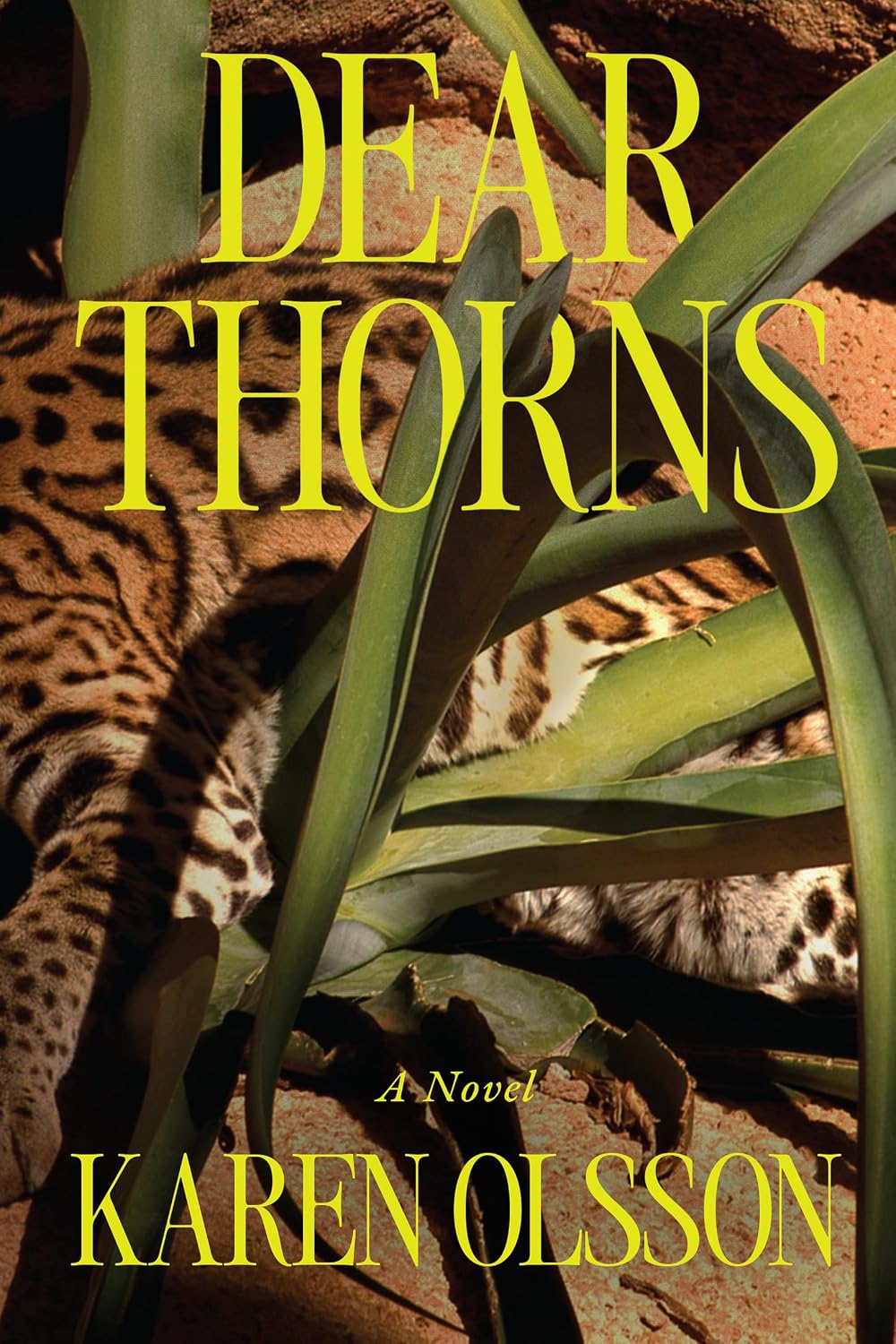
It marks the third installment in Olsson’s trilogy of blighted idealism. In Waterloo, the cynical realities of Texas politics and journalism defeat efforts to use each to make the world a better place. In All the Houses, a daughter’s reverence for her father, a former official at the National Security Council, is undercut by revelations of his implication in the Iran-Contra scandal. In the latest novel, Lora’s dedication to making the world safe for ocelots collides with her discovery that: “The world was more and more propelled toward algorithms and bottom lines, and if you resisted those imperatives you were punished.”
Toward the end of Dear Thorns, Lora crawls through dense thickets on her hands and knees in search of a GPS device that has fallen off an ocelot’s collar. Scratched and bleeding from the thorns in the brush, she is in agony. But, doing exactly what she, a conservation biologist, should be doing, she is exhilarated.
“Long live the weeds and the wilderness yet,” proclaims Gerard Manley Hopkins in his poem “Inversnaid.” Weeds and thorns are the tonic necessary to a vibrant life. The thorns are dear to Lora because they provide her with a reason to resist, however wistfully.
You May Also Like

Bobby Pulido, the New Scion of South Texas Democrats
The Tejano star ousted a two-term Republican incumbent, but now that the music’s over, what kind of congressman will he be?

Inundated by ICE and Rising Costs of Living, South Texas Returns Home to Democrats
After two years of being ground zero for the Trump administration’s nationalist policies, the region dramatically swung for Dems after flipping red in 2024.

South Texas Is Moving On from Trump
The region looks poised to return to its centrist-Democrat roots, as the president fails to bring down costs and the reality of mass deportations takes hold. But 2028 could be another test.