
‘Cocks Not Glocks’ at 10
A decade on, the iconic campus protest has come to symbolize a time of relatively free expression.
A version of this story ran in the July / August 2026 issue.
Since August 1, 2016—50 years to the day after the UT Tower shooting—it’s been legal to carry concealed firearms into most public university spaces in Texas, including classrooms.
When the law went into effect despite opposition from students, administrators, and faculty, University of Texas at Austin students reacted by brandishing dildos in a performance-art-style, nonviolent protest that earned national media attention. After the idea spread in a half-joking social media post, student protesters wore T-shirts, held signs and banners, and strapped dildos donated by local shops to their backpacks, all to mock masculine gun culture and the Texas laws that regulate sex toys more heavily than firearms on campus.
“Texas has decided it is not at all obnoxious or illegal to allow deadly concealed weapons on campus. But walking around with a dildo could land you in trouble,” protest organizer Jessica Jin said at the time. “We’re protesting absurdity with absurdity.” The viral protest was one of the largest gun-control rallies the state had yet seen.
Today, “campus carry” is still in effect, and the obscenity statute regulating sex toys is technically on the books, too, despite a U.S. district judge calling it “facially unconstitutional” and “unenforceable” in 2008. Since then, the Legislature has doubled down, and in February, a federal appeals court ruled that Texas can enforce its latest obscenity law, which targets drag shows and prohibits “sexually oriented performance,” including the exhibition of sex toys and “accessories or prosthetics that exaggerate male or female sexual characteristics.” Meanwhile, researchers at Johns Hopkins University found that, while policies allowing guns on campus don’t reduce mass shootings, gun access “substantially increases” the risk of suicide among young adults.
Dildos were a means to an end in the gun-control-focused “Cocks Not Glocks” protest, but they were, and remain, a complex protest symbol.
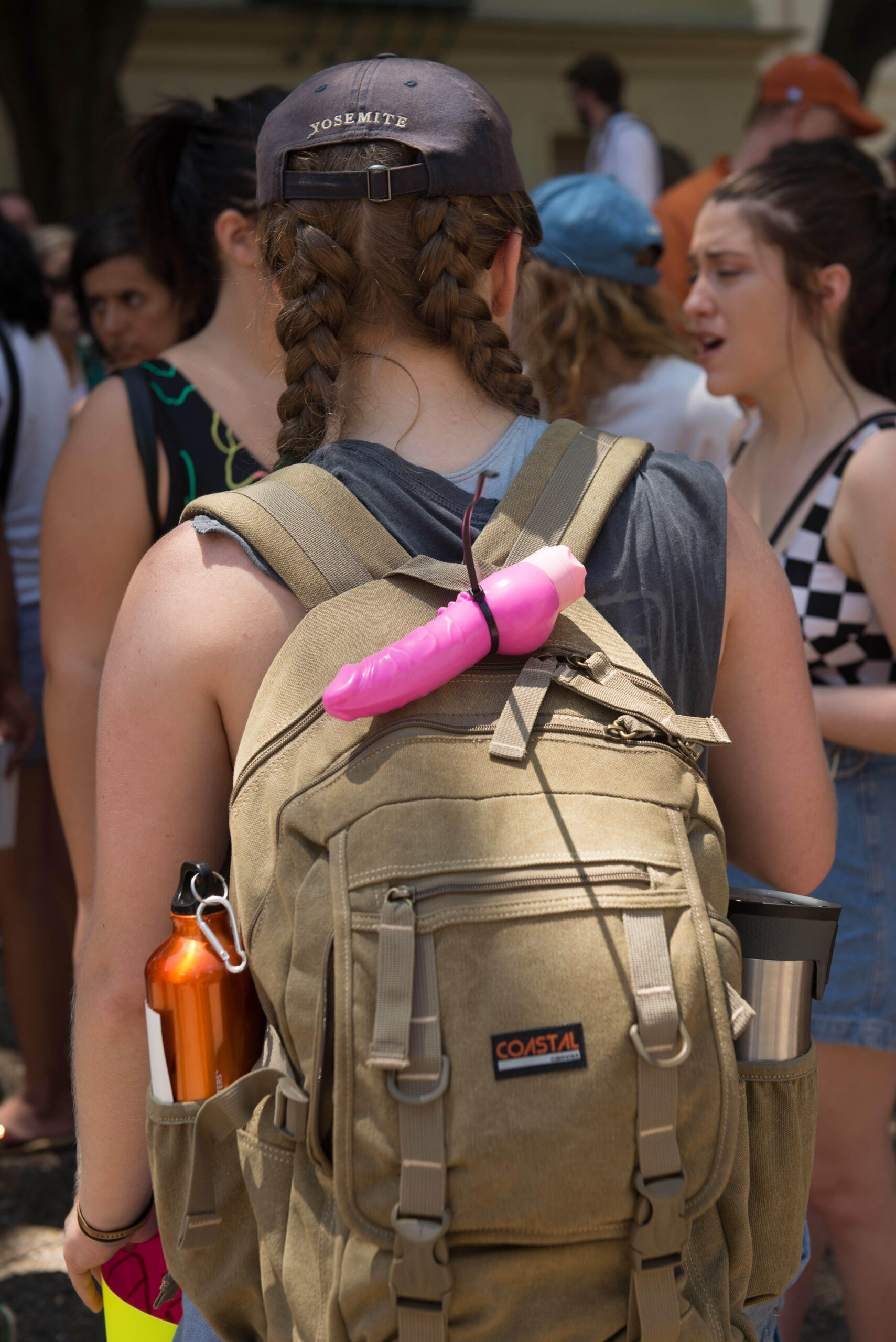
Some of the Cocks Not Glocks protest’s most intentionally provocative imagery was also its most Texas-specific. The protesters inverted the Battle of Gonzales slogan, “Come and Take It” (already reused by the Tea Party and a Texas gun activist group), to read, “Take It and Come,” and designed a modified version of the famous cannon and star flag, replacing the cannon with a dildo.
Despite the protest’s specificity to Texas, international interest in unraveling the layers of the sophisticated joke at the core of Cocks Not Glocks continues. In a 2024 academic article, Lotta Kähkönen, a scholar based in Finland, used a close reading of online backlash to the protest and interviews conducted at the University of Texas by a Finnish team in the spring semesters of 2018 and 2019 to trace the ways reactions to the dildos were steeped in the objects’ cultural valences, “driving discussions about obscenity, feminism, phallic symbols and sexuality.” Kähkönen points out that “In the United States, themes of protectionism and opposition to ‘immoral’ sexual behavior and pornography have been highlighted in the right-wing agenda after 1977, when strategists discovered that they had a mass appeal.”
In opposition, dildos as protest symbols were (and are) associated with “sex positivity.” Bringing a sex-positive symbol to oppose gun violence, the student activists of Cocks Not Glocks revived the spirit of the “Make Love not War” movement of the 1960s, which linked sex positivism to nonviolence. “Love-ins” against the Vietnam War and political violence occurred on UT’s campus in 1968.
The playfully subversive atmosphere of the Cocks Not Glocks protest meant the students could not be dismissed as angry feminists. Yet they did receive sexist backlash and other criticism. The protest organizers also confronted historical associations that complicated the use of this imagery. After an image of a large black dildo displayed at the protest went viral, the protest organizers apologized for unintentionally perpetuating a racist caricature of Black bodies and painted the dildo burnt orange, UT’s school color.

Engaging in frequent interviews with media outlets, student organizers largely managed to navigate their chosen symbol’s complexity. Framing campus carry as a law that would chill free speech, they argued that if a classroom disagreement could potentially escalate into a firefight, it was unlikely anyone would feel safe enough to challenge a fellow student to a debate. Through this framing, the protesters situated themselves as more comfortable with free speech and the exchange of ideas than the uptight Legislature. The associations they tapped—connecting freedom of speech and sex positivity—go back to at least 1873, when Comstock laws criminalized mailing material related to contraception and family planning by labeling it obscene.
In recent months, dildos have again emerged as a protest prop, this time in opposition to Immigration and Customs Enforcement (ICE). In one demonstration, protesters stuck dildos into the chain-link fence surrounding the Whipple Federal Building in Minneapolis. In another incident, a member of the “Dildo Distribution Delegation” threw a dildo at ICE agents outside the Minneapolis Graduate Hotel in an effort to “psychologically dismantle” the federal law enforcement agency. These dildo-based protests, unpegged from a critique of obscenity laws, are part of a recurring thread in protests against ICE’s disruptive presence in American cities, critiquing MAGA machismo.
The shock factor of hundreds of dildos made the Cocks Not Glocks protest memorable, and the conversation that it launched at UT continued beyond the demonstration. UT anthropology professor Craig Campbell added a dildo in the color “gunmetal gray” to a department exhibition case in the UT Student Activity Center, where it was on view for two years. The protest event opened a door for a teachable moment about phallic symbols through an anthropological lens. Campus Carry, a book published by Harvard University Press in 2020, edited by UT professors Matt Valentine and Patricia Somers, includes reflection pieces from students, alumni, and faculty to illustrate the complexity and controversy of the campus-carry policy that sparked the protest. Ellen Spiro & PJ Raval created an award-winning 25-minute documentary about the protests titled Come and Take It. “Gun Free UT” posters continue to appear in campus windows.
Today, however, free speech on Texas public university campuses faces a chill that makes the environment far less hospitable to both student and faculty speech. Student-led demonstrations against the bombing of Gaza were met with forceful arrests by Texas state troopers in 2024. UT students who attempted to schedule a meeting with Provost William Inboden in November 2025, and staged a brief sit-in when the request was denied, were given suspensions. The UT Board of Regents directed faculty to limit classroom discussion of controversial subjects, in a policy that PEN America’s Campus Free Speech Program Director Kristen Shahverdian says “will harpoon any chance students have of a valuable college education at the University of Texas.”
Administrators are cracking down especially hard on evocations of sexuality. The University of Texas System, Texas A&M, and other universities blocked drag shows in their zealous efforts to comply with a January 2025 executive order. Under a new policy, Texas A&M faculty have been forced to cancel or modify courses that touch on topics related to gender and sexuality, which has already resulted in the baffling removal of Plato readings related to gender from a philosophy course. UT-Austin announced it will consolidate the department of Women’s, Gender and Sexuality Studies; American Studies; African and African Diaspora Studies; and Mexican American and Latino Studies into a single Social and Cultural Analysis department. Faculty are calling the step a culture-war move to destabilize departments.
“There is zero trust in our administration to be fair or reasonable,” said Campbell. “It feels like we’re sitting on a powder keg.”
The recent series of policies and actions contrasts starkly with the official response to the Cocks Not Glocks protest, during which UT-Austin administrators said the students appeared to be engaging in protected political speech and did not attempt to intervene.
In 2026, student demands for gun control take a different form. On March 3, students gathered on UT’s South Mall to mourn the victims of the recent mass shooting on Austin’s Sixth Street. At the event, members of Students Demand Action called for common-sense gun laws, as the attendees held candles and flowers.
You May Also Like
Texas History Offers Warnings amid Rash of Faculty Firings
Lessons to learn from the politically motivated firing of a UT president in the 1940s
Amid New McCarthyism, the Alliance for Texas History Embraces Diverse Scholarship
“It’s particularly important at a moment when our state leaders have demonstrated that they don't want students to have a really full, inclusive accounting of our state or national past.”
Texas Shouldn’t Legislate Censorship
Public libraries are for the public—and that means access for all.