
Fast Cash: How Taking Out a Payday Loan Could Land You in Jail
Payday loan companies have a new debt-collection tool: Texas courts and prosecutors.

When Roger Tillman lost his job, he knew money would be tight. But he never thought he could end up in jail for being broke.
Tillman’s job as a late-night security guard in Houston had paid $9 an hour, and by picking up extra shifts, Tillman could just afford rent, groceries and other bills. But in 2008, amid the economic collapse, the security company scaled back overtime shifts, straining his finances. Worried that he couldn’t pay his bills, Tillman reluctantly went to The Money Center, a payday loan company with locations in San Antonio and Houston.
He took out a $500 loan. The 64-year-old Houstonian doesn’t recall the exact terms of the loan, but The Money Center’s website currently offers a $500 loan at 650 percent annual interest, or about $150 in fees and interest for a two-week loan. Such terms are common in Texas, where payday and car title lenders are allowed to charge customers unlimited fees.
Like many low-income borrowers, Tillman found he couldn’t fully pay off the loan when it came due. Instead, the lender offered to roll it over for another two weeks and tack on another round of fees. Tillman took on more payday loans to pay off the original loan and soon found himself in deepening debt. And then, in October 2009, he was laid off.
Tillman said he lost his job on a Wednesday and by Friday he was calling The Money Store to ask for an extended payment plan. No one called back. With his bank account empty and hoping to avoid overdraft fees, Tillman halted the automatic withdrawals he had set up for monthly payments on his payday loans. Eventually, he reached a manager at The Money Store.
“His statement was that ‘I hope you don’t get stopped by the police, because I’m filing a theft by check charge against you,’” Tillman said. “I didn’t say anything. I was floored, because I was expecting to work out a payment plan.”
It was no idle threat. In November 2009, The Money Center, which is the operating name for a company called Marpast of Texas, filed a criminal complaint against Tillman with the Bexar County district attorney in San Antonio. Tillman soon received a letter from the DA, demanding that Tillman pay Marpast $1,020 within 10 days or potentially face felony theft charges that carry two to 20 years in jail and fines up to $10,000. In all, the district attorney demanded $1,250, including “district attorney fees” of $140 and merchant fees of $90.
Tillman was shocked and scared. When his daughter graduated from basic training at Lackland Air Force Base in San Antonio, Tillman almost didn’t attend out of fear that there was a warrant for his arrest in San Antonio.
“I’m innocent here,” he said, “other than losing my job and an inability to pay. I tried to get on a payment plan. If my intention was to duck and dodge, why would I even call them?”
In Tillman’s case, however, the debt collectors weren’t exactly lying: He could be arrested for not paying his payday loan debt.
An Observer investigation has found at least 1,700 instances in which payday loan companies in Texas have filed criminal complaints against customers in San Antonio, Houston and Amarillo. In at least a few cases, people have ended up in jail because they owed money to a payday loan company. Even when customers avoided jail, the Observer has found, payday loan companies have used Texas courts and prosecutors as de facto collection agencies.
This is despite state laws that forbid payday loan companies from even threatening to pursue criminal charges against their customers, except in unusual circumstances. The law specifically prohibits theft charges when a post-dated check is involved. (Most payday loans require borrowers to provide a post-dated check or debit authorization to get the money.) The state Office of Consumer Credit Commissioner has advised the payday loan industry that “criminal charges may be pursued only in very limited situations” where it can be proven that a borrower knew a check would bounce.
The Consumer Service Alliance of Texas, a trade association representing 80 percent of Texas’ payday and title loan companies, is even more strict about the practice. “Members will not threaten, or pursue, criminal action against a customer as a result of the customer’s default on a credit service agreement,” according to the group’s website.
“I think the idea of debtors’ prison is offensive to most people and that’s why we have prohibited this in the law,” said Ann Baddour of Texas Appleseed, an Austin-based organization that advocates for the poor. “It’s clearly established in the law that unless there’s criminal intent on the part of the borrower, there’s not an option to pursue criminal charges.”
Still, payday lenders have found courts and prosecutors willing to take cases. The practice threatens to jail people for debt.
Until debtors’ prisons were banned 180 years ago, Americans could be jailed for years for owing just a few pennies. The costs of incarceration, though minimized by squalid prison conditions, often grossly exceeded the debts, suggesting that punishment was the overriding motive.
In the first two decades of the 19th century, humanitarians confronted authorities in several states with a litany of abuses, and the public came to see the practice of jailing debtors as repugnant. New York was the first state to abolish incarceration for debt. Other states followed, and Congress passed a federal statute banning the practice in 1833.
The Republic of Texas Constitution, drafted just a few years later, in 1836, establishing Texas as an independent nation, declared, “No person shall be imprisoned for debt in consequence of inability to pay.”
In some respects, Texas law tilts strongly toward debtors’ rights. Texans’ property is largely shielded from seizure by creditors. Wages can’t be garnished for consumer debt.
But it’s nonetheless increasingly common for people to be arrested for unpaid debts, including in Texas. In 2011, The Wall Street Journal reported that more than a third of states allow borrowers who can’t or won’t pay debts to be jailed, even in states that prohibit debtors’ prisons. Debt-collectors and other financial firms, the newspaper reported, are suing borrowers over unpaid credit cards, consumer loans, auto loans and other debts. Many people report never receiving a notice of the lawsuit and end up with an arrest warrant obtained through the courts. However, in Tillman’s case and others in Texas, some payday lenders have found an even more direct way to harness the power of the criminal-justice system.
The Observer has found a justice of the peace in Harris County who has handled almost 300 hot-check cases, a Class C misdemeanor, for Cash Biz, an Ohio-based payday lender with 24 locations in Texas. Though Class C misdemeanors rarely carry jail time, at least a few people have served time in the Harris County jail to work off their debt, at $300 a day.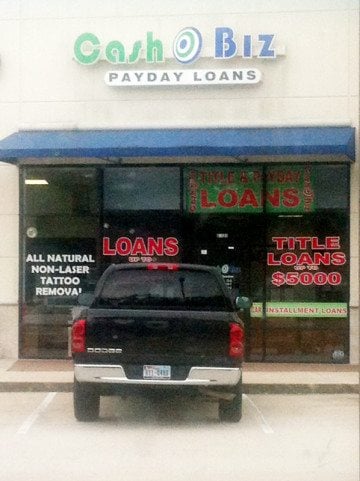
Christina McHan failed to repay a $200 loan from Cash Biz near Houston. In November 2012 she was arrested, pleaded guilty, and was assessed $305 in additional fines and court costs. She spent a night in jail to “pay off” the debt.
In Amarillo, the wife of a military veteran with 23 years of service complained to the Office of Consumer Credit Commissioner that the Potter County Attorney was pursuing theft charges against her husband even though the couple was in bankruptcy. “My husband is a good man!” she wrote to the credit commissioner. “He has never done anything wrong, he fought for this country for 23 years … and now the Potty [sic] County Attorney wants to prosecute him for a payday loan.”
In an emailed response to questions from the Observer, Assistant Potter County Attorney T. Eric Dobbs wrote that his office doesn’t receive many cases from payday lenders, but the ones they do get typically involve a borrower who has closed their bank account after taking out a loan, or someone who “could not keep up with the recurring fees so they stopped paying in hopes that a case will be presented to our office.” Dobbs didn’t respond to follow-up questions, including why a borrower would hope to face criminal prosecution.
Belinda Cinque, the hot-check clerk for Justice of the Peace Tom Lawrence in the Houston suburb of Humble, said she has little choice but to take payday lenders’ criminal complaints. “If all of the elements match, I’ve got to take it,” she said. But she expressed discomfort with the situation, noting that the vast majority of borrowers had either lost their jobs or had their hours reduced at work. “Correct me if I’m wrong, but they sound like sharks,” Cinque told me. At some point last year, she started getting calls from people—some in tears—making payments to Cash Biz through the court. A collection agency was “threatening them that they were going to be taken to jail,” Cinque said. To her, it sounded like the debt was being collected from two directions—a debt-collection company and through the court. She told Cash Biz to stop filing hot-check complaints as long as the company was using debt collectors.
The court, Cinque said, gives borrowers as much time as possible to pay and tries to avoid issuing warrants.
Almost all of the cases in Lawrence’s Harris County court emanate from Cash Biz, which appears to have found a way around the prohibition on prosecuting “held” or post-dated checks. Most payday loan companies in Texas have their customers fill out a post-dated check or authorize an electronic debit from a checking account for a future date. When the loan is due, the company either cashes the check or debits the account. That is, unless the customer doesn’t have the money and wants to “roll over” the loan. Cash Biz, on the other hand, gets checks from their customers dated for the day of the transaction. If the customer doesn’t come in and pay on the loan before the due date, the company can try to cash the check. If it bounces, then the company claims it has the basis for a hot-check charge. (Reached by phone, Cash Biz President David Flanagan said he would have someone else in the company call me back. No one did.)
Baddour, the consumer advocate, said that Cash Biz’s “innovation” points to a persistent problem with the payday loan industry in Texas.
“What we’ve seen over and over again is that [payday lenders in Texas] are pushing the limits of the law, always finding the loopholes, finding ways to navigate through the law,” she said.
Still, it’s not clear that the Cash Biz model is kosher. Taking out a payday loan isn’t like writing a hot check for groceries. Regardless of when you date the check, you’re borrowing money because you don’t have any. The promise is that you will eventually pay the money back with interest. In the payday loan model, the check is security for the loan, not payment.
Asked about the Cash Biz prosecutions in Harris County, Rudy Aguilar, director of consumer protection for the state Office of Consumer Credit Commissioner, responded, “We don’t believe that it would be appropriate in that scenario to move forward with those charges,” he said. “Now, we can’t tell that J.P. court how to interpret this.” Aguilar said the agency was unaware that the justice of the peace court in Humble was pursuing criminal charges against Cash Biz customers.
Defense attorney Jeff Ross, who specializes in hot-check cases in Houston, said that payday loan customers aren’t committing a crime, because the payday lender accepts the check knowing that it’s not good at the time the loan is given.
“If I want to be a hard-ass about it I’d say, ‘Listen we’re not going to pay a nickel,’” Ross said. “This doesn’t even belong in this court. It’s a hold check and therefore it’s not a criminal case.” While he doesn’t see anything patently illegal about the JP court’s practice, the intent is clear. “The payday loan people file with the JP court and use them as muscle to collect their money.”
As Roger Tillman began looking into how to avoid jail time, he grew angry. He wrote letters to Marpast, the state Office of the Consumer Credit Commissioner and the Bexar County DA. His complaint to the credit commission triggered an investigation.
Marpast would later tell the state Office of Credit Consumer Commissioner in writing that it had submitted the debt to the Bexar County DA “for collection purposes.” Indeed, First Assistant District Attorney Cliff Herberg described the hot-check division as “an assembly line process” in which “the vast majority of [cases] don’t get prosecuted.”
So is the DA’s office functioning as a debt-collection service for payday lenders?
“Well, we send a letter out,” Herberg told the Observer. “That’s part of the services that are offered.” The DA, he said, can’t decide which merchants to work with or not, even if “payday lenders may not be the favorite in the community.”
Herberg said his office won’t prosecute cases in which a payday loan is involved unless there’s a clear case of fraud or deception. “If it’s for a loan, they’re not going to submit them to a criminal prosecution, it would be for collections purposes only.” However, the collections letters from the Bexar County DA threaten arrest, jail and criminal prosecution—an inconsistency that the credit commission noted in its correspondence with Marpast.
“You would think that if this was a legitimate fraud or suspected fraud or suspected theft by check, that would’ve come up somewhere in the letter” from Marpast to the credit commission, Tillman said. “Because [Marpast] knew and the DA for that matter knew it was bullshit. It was an attempt to collect on a debt by coercion.”
There were other details that bothered Tillman. For one, the outstanding loans were for $500 and $350, respectively, not the $1,020 that Marpast was demanding. He also bristled at the thought that the Bexar County DA’s office was profiting from its collections letters.
“When you multiply a $140 processing fee times a 1,000 or 2,000 or 3,000 people who are delinquent, that’s a hell of a lot of money. That’s a way of putting money in your coffers. And all you’ve got to do is put something down on your letterhead.”
In all, the Bexar County DA has accepted more than 1,400 criminal complaints from payday lenders since 2009 totaling almost $373,000, according to records from the DA’s office obtained by the Observer.
The Office of Credit Consumer Commissioner has occasionally told payday lenders to stop seeking criminal charges against customers, but the agency has no jurisdiction over judges or prosecutors. After Tillman wrote to the consumer credit commissioner in August to complain about his situation, the agency investigated. In a September letter to Marpast, the agency instructed the company to “advise the DA’s office to cease collection activities on all checks” forwarded by Marpast. This should keep Tillman and other borrowers out of jail.
While the commission ordered Marpast to stop, its policing in general is spotty.
Since the Texas Legislature assigned the agency the duty of overseeing payday and title loans in 2011, it’s been stretched thin. The consumer credit commission has 30 field examiners to cover 15,000 businesses, including 3,500 payday and title lenders.
“Although I’d love to take a bunch of folks and go at that one issue,” said Aguilar, the director of consumer protection, “I don’t have that luxury at the moment.” Aguilar said his team finds violators when consumers complain or when the agency’s examiners visit one of the stores for an inspection. Only two customers, including Tillman, have ever complained to the commission.
“It’s a difficult situation,” Aguilar said. “People get put in tough situations where they’re just not armed with enough knowledge to deal with [payday lenders], and they get intimidated. If somebody calls you and tells you that you’ve violated the law in a criminal manner, that’s going to get your attention and shake you up.”
You May Also Like

Bail Crackdown on Ballot Ignores Mental Health Crisis, Advocates Say
"The jail system is already the largest warehouse of people with mental illness in the state of Texas."

Abbott’s Bail Agenda Could Swell Texas Jails, Test U.S. Constitution
Republicans want to double down on a system that can keep Texans in jail for years without a trial, while attacking bail funds that try to help.

Costly New Bail Bills Would Needlessly Jail More People
Texas politicians are wasting your money to punish the working class.