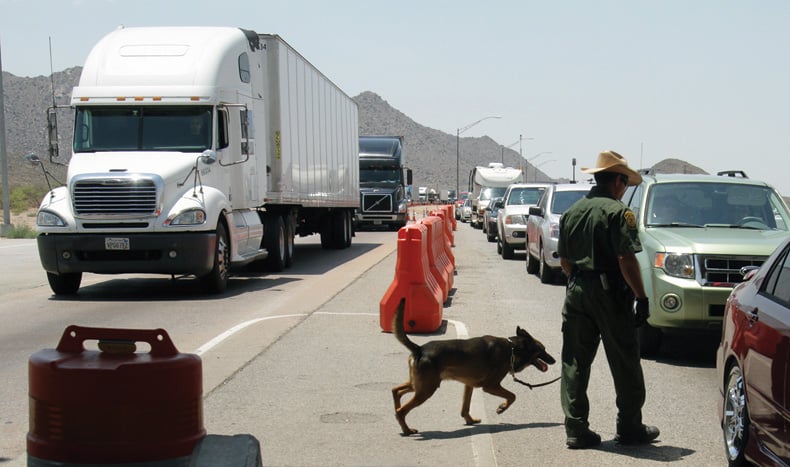
Border Patrol Takes ‘No’ for an Answer at Internal Checkpoints

A fascinating video is circulating on the Internet featuring motorists who decline to answer questions at Border Patrol checkpoints miles from the border. Questions like, “Are you a U.S. citizen?” or “Where are you headed?” are met with polite refusals. In the video, one pair of motorists stopped at a Laredo checkpoint refuse to answer an agent’s question about their citizenship. When the agent becomes agitated and orders the driver to pull over to secondary inspection, the driver politely says, “No thank you.” The agent calls over his supervisor. “Unless we’re living in a police state,” the driver says. “Unless this is Mexico or Nazi Germany … this is still America and I can travel down this road without having to answer questions from federal agents.” The kicker is the motorists get away with it; the supervisor ultimately waves them through.
http://www.youtube.com/watch?v=u4Ku17CqdZg
This was a surprise to me because I grew up in the Rio Grande Valley where travelers must pass through an internal checkpoint in Sarita or Falfurrias to reach points north. The Border Patrol operates a total of 71 permanent and tactical checkpoints on the southwest border, according to a 2008 report by the U.S. Government Accountability Office. (Tactical checkpoints do not have permanent buildings. They support permanent checkpoints by monitoring and inspecting traffic on secondary roads that the Border Patrol determines are likely to be used by undocumented travelers or smugglers.) As the checkpoints have proliferated, so has concern over the rights of motorists. Critics of the internal checkpoints say they violate the Fourth Amendment prohibition on “unreasonable searches and seizures.”
Still, it was unclear to me if you are legally obligated to answer Border Patrol agents’ questions. What, exactly, are your rights and responsibilities at these checkpoints? I put the question to a few legal experts.
Denise Gilman, co-director of the immigration clinic at the University of Texas School of Law, says that Border Patrol agents at internal checkpoints are allowed to ask motorists basic questions about citizenship, identity and travel itinerary, but they cannot detain you or search your vehicle without probable cause. Your refusal to answer questions would not provide probable cause to allow for such a detention or search, she added.
“So, if you refuse to answer, they can pull you out of the line and over into ‘secondary inspection’ and they can probably hold you there for about 20 minutes or so,” she said. “But they cannot do anything more if you continue to refuse to respond unless something else develops during that time period that would lead to probable cause.”
More than one motorist in the video declined to pull over into secondary inspection, yet they were allowed to go on their way without incident.
“I don’t know of any case where the person has refused to go into secondary inspection as in the YouTube video,” says Barbara Hines, a clinical professor of law at UT who co-directs the immigration clinic with Gilman. “But it is a very interesting civil disobedience idea. Because in order to arrest the person, the Border Patrol, again, would need probable cause.”
I happened to have a trip planned to the Valley last weekend. On my way back to Austin, I stopped at the checkpoint in Sarita. Rather than refuse to answer the question, “Are you a U.S. citizen?” I asked the agent whether or not I was legally obligated to answer. She was taken aback at first, asking if I was going to pull a camera on her. I told her I was doing a story for the Texas Observer, which probably ensured that I would get out of there without a hassle.
Her supervisor referred me to the Border Patrol Public Affairs Office in Falfurrias and I went on my way never having revealed my citizenship.
By email later, a Border Patrol spokesman gave me the answer I was looking for: “Although motorists are not legally required to answer the questions ‘are you a U.S. citizen and where are you headed,’ they will not be allowed to proceed until the inspecting agent is satisfied that the occupants of vehicles traveling through the checkpoint are legally present in the U.S.”
Border Patrol agents are granted authority to question the occupants of vehicles traveling through an established checkpoint based on U.S. vs. Martinez-Fuerte. That was a 1976 Supreme Court decision that said permanent or fixed checkpoints set up by the U.S. Border patrol on public highways leading to or away from the Mexican border are not a violation of the Fourth Amendment.
Congress also gave the Department of Homeland Security authority, through the Immigration and Nationality Act, to conduct searches within a “reasonable distance” of the border, which DHS defines as 100 miles.
Hines points out, however, that federal laws and regulations are subordinate to the Constitution.
So it seems you are within your rights not to answer the Border Patrol agent at an internal checkpoint (this doesn’t go for actual borders!), but the agents are also within their rights to ask you about your citizenship. At least for a while. After that, they’d need probable cause to detain you.
You May Also Like
My Home Is Treated Like a War Zone. That Militarization Expanded to Minnesota.
There have been many violent murders at the hands of Border Patrol agents. This is not an aberration but part of a broader federal apparatus built and refined over decades.
The Banality of Border Evil
What a long-dead, cartoonishly corrupt Texas bureaucrat can tell us about the nature of immigration enforcement and the U.S.-Mexico divide
The Border Patrol’s Power Grab
The agency seeks more authority from the Legislature to nab trespassers and others in Texas.